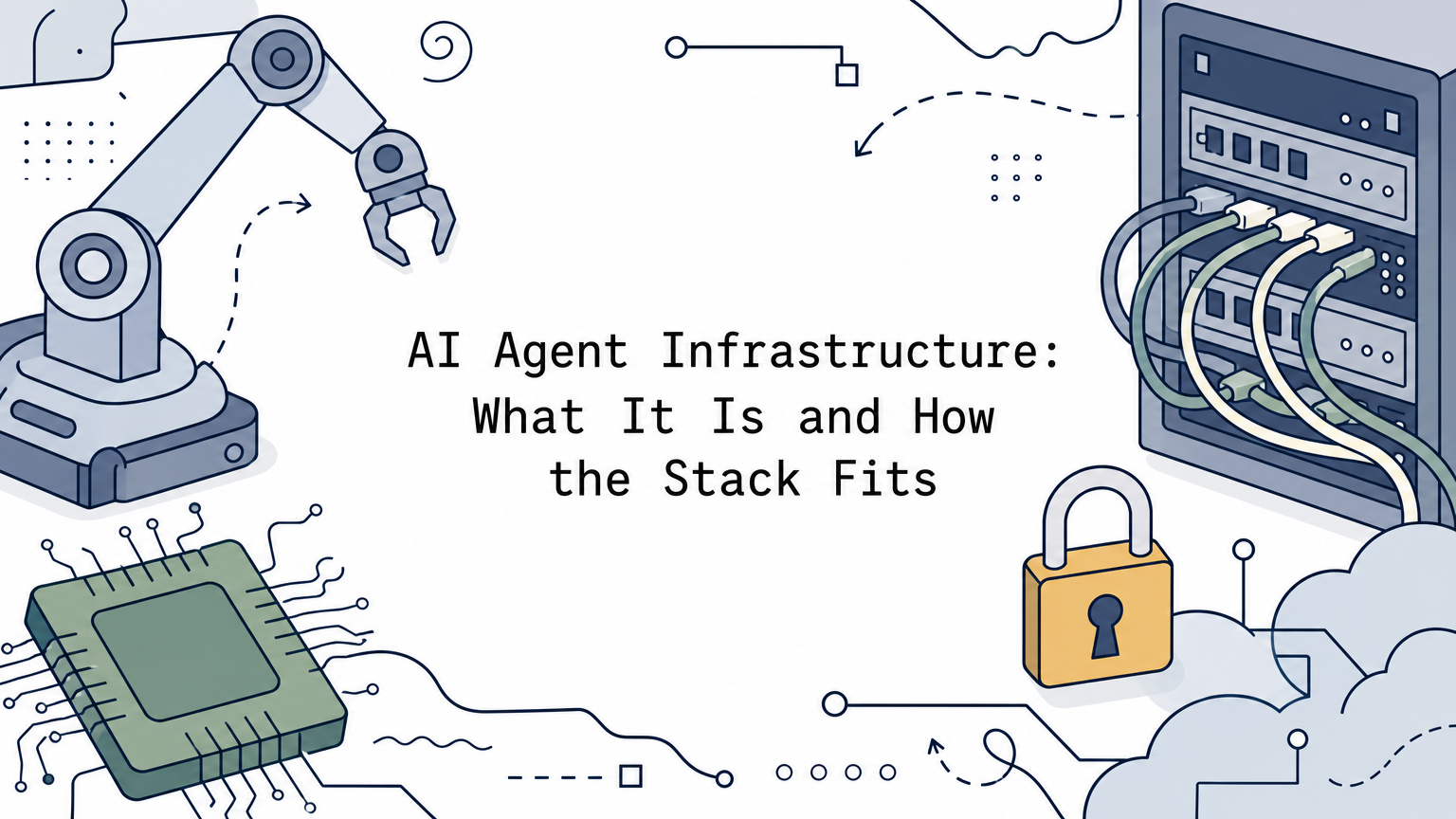
AI agent infrastructure is everything an autonomous agent needs around its model to do real work. That means a runtime that executes it, orchestration that sequences its steps, storage for memory and state, connections to tools, identity and permissions, and observability to see what happened. The model decides what to do. The infrastructure decides whether that decision runs reliably, safely, and at a cost you can predict.
This article explains why the stack matters now, how to build it layer by layer, how the inference layer affects everything above it, and which failures show up most often in production. By the end you should be able to sketch your own stack on a whiteboard and know which layer to fix first.
Geodd runs the inference layer for teams building agents and applications. That gives us a close view of which parts of the stack hold up under long-running work and which ones quietly break, and that experience shapes the advice below.
Why AI agent infrastructure matters
AI agent infrastructure matters because an agent is a program that makes its own decisions over minutes or hours, and ordinary application infrastructure was not designed for that. A chatbot answers one prompt and forgets. An agent plans, calls tools, reads the results, and loops until the job is done. Every one of those loops needs somewhere to run, somewhere to remember, and something watching.
Why demos work and production fails
A demo runs once, on clean data, with a developer watching. Production runs thousands of times, on messy data, with nobody watching. The gap between the two is almost never the model. It is a missing retry, a shared API key, a state store that vanished on restart, or a bill nobody saw coming.

Gartner predicted that more than 40% of agentic AI projects will be canceled by the end of 2027, pointing to escalating costs, unclear business value, and inadequate risk controls. Two of those three reasons are infrastructure problems: cost visibility and control.
A good model in a weak stack still fails, because the failure happens around the model.
What the rise of AI agent infrastructure reflects
The early work in this field was about prompts and model choice. The rise of AI agent infrastructure reflects a shift to a harder question: how do you run this thing every day? Four properties of agents explain why the old playbook falls short:
- Long-running: a single task can take minutes or hours, which breaks request-and-response timeouts.
- Stateful: the agent must carry context across steps, and models themselves do not remember anything between calls.
- Non-deterministic: the same input can produce different tool calls, so you cannot test every path in advance.
- Acting on live systems: agents write records, send messages, and spend money, so mistakes have consequences.
Each property maps to a layer in the stack, which the next section covers.
How to build an AI agent infrastructure stack
Build the stack from the bottom up: inference and runtime first, then state, tools, orchestration, identity, and observability. Each layer has one job, and skipping a layer shifts its work onto the layers around it, usually in a way that hurts later.
The six layers and what each one does
The table below sets out what each layer owns, what breaks when it is missing, and common building blocks.
| Layer | Its job | What breaks without it | Common building blocks |
|---|---|---|---|
| Runtime | Executes agent code, often for long periods | Runs die on timeouts or restarts | Containers, Kubernetes, job queues |
| Orchestration | Sequences steps, branches, retries, hand-offs | Loops, stuck runs, no recovery path | LangGraph, CrewAI, custom state machines |
| Storage and memory | Holds state, history, and retrieved knowledge | The agent forgets or repeats work | Postgres, Redis, pgvector |
| Tools and integrations | Connects the agent to APIs and data | Silent failures, schema drift | REST APIs, Model Context Protocol servers |
| Identity and security | Defines who the agent is and what it may touch | Overbroad access, data leaks | Scoped keys, OAuth service accounts, audit logs |
| Observability | Records what the agent did and why | Failures you cannot explain | OpenTelemetry traces, cost dashboards |
Underneath all six sits model inference, the API that returns each next decision. The next section covers it separately because it sets the speed and cost of every step.
How a single request flows through the stack
Take a support agent that handles refund requests. The flow shows how the layers fit together:
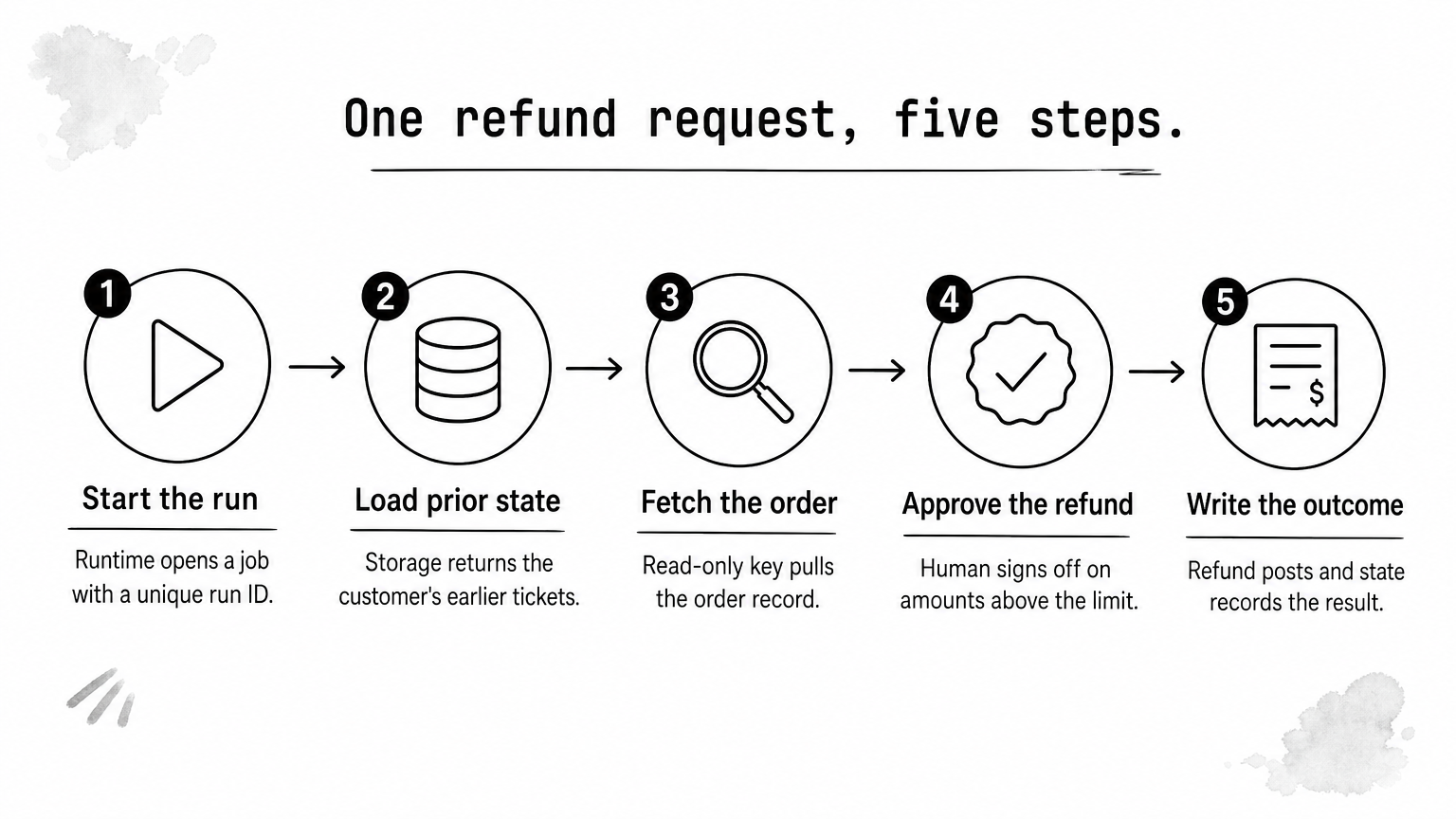
- A ticket arrives and the runtime starts a job with a unique run ID.
- Orchestration loads the run's state from storage, including the customer's prior tickets.
- The agent calls the model through the inference API and decides it needs the order record.
- A tool call fetches the order, using credentials scoped to read-only order data.
- The model proposes a refund. Orchestration pauses for human approval above a set amount.
- After approval, a second tool call writes the refund, and state updates with the outcome.
- Observability has logged every model call, tool call, latency, and token count under the run ID.
If step 4 times out, orchestration retries it. If the process dies at step 5, storage lets the run resume instead of starting over.
Design every layer around one question: what happens when this step fails halfway?
Put identity and observability in from day one rather than after the first incident. Adding scoped credentials and traces to a running system means touching every tool call you already wrote.
How the inference layer shapes AI agent infrastructure
The inference layer sets the floor for the rest of your AI agent infrastructure, because every agent step is a model call, and a slow or flaky call stalls the whole run. Most teams treat inference as a commodity until they watch a 30-step task crawl.
Latency, retries, and long-running tasks
Consistency matters more than peak speed. A 30-step run at 2 seconds per call finishes its model time in about a minute. At 6 seconds per call it takes three minutes, and every timeout or error adds a retry that repeats cost and delays the user. Variable latency also makes timeouts hard to set, so you either cut off healthy calls or wait on dead ones.

This is the problem Geodd's inference service targets. It offers serverless and dedicated deployment, and it feeds tested kernel improvements back into serving so performance stays steady on long agentic workloads.
Choosing a model and an endpoint
Pick the model per task, not per stack. Because Geodd exposes an OpenAI-compatible API, moving an existing agent over means changing the base URL and API key in the OpenAI SDK, so you can test several models without rewriting orchestration code.
Three current options illustrate the choice:
- GLM 5.3 Flash suits coding assistance, debugging, and long-context document analysis.
- DeepSeek V4.1 Flash targets reasoning and long-context applications.
- GPT-OSS-120B offers reasoning, tool calling, and regional endpoints.
Check each model page for tool-calling and structured-output support before you commit, since endpoints for related models do not always share the same capabilities. Also check data handling. Geodd applies a Zero Data Retention policy, runs in US-EAST and EU-NORTH, and is GDPR-ready, which helps when agents touch customer records.
Treat inference as a component you can swap, and keep your agent code ignorant of which model sits behind it.
Common failure points and how to avoid them
Most production failures trace back to a short list of gaps: unbounded loops, overbroad credentials, state held only in memory, missing traces, and no named owner. All of them are cheap to prevent early and expensive to fix after an incident.
Failures of control
An agent without limits will eventually loop. Set a maximum step count and a spend ceiling per run, and have orchestration stop and escalate when either is hit. A circuit breaker on cost is as important as one on errors.
Credentials fail in the same quiet way. A single shared key means one confused agent can reach everything. Give each agent its own identity, grant least-privilege access to only the tools its job needs, and separate read paths from write paths. Require human approval for irreversible actions such as payments or deletions, at least until the run history justifies trust.
Failures of visibility
Teams often keep state in process memory because it is the easiest option in a prototype. When the container restarts, the run is lost. Move state to a database keyed by run ID, and checkpoint after each step so a run can resume from the last good point.
Then trace everything. Log each model call, tool call, latency, and token count under one run ID, using a standard such as OpenTelemetry so you are not locked to one vendor. Review a sample of runs weekly for correctness, not just errors, because agents can fail while returning a confident answer. Finally, name one person who owns the operation and gets the call when it breaks. A stack with no owner is an experiment.
If you cannot replay a failed run from its trace, you cannot fix it.
Start with the layer that hurts most
AI agent infrastructure is the set of layers that turns a capable model into a dependable worker: runtime, orchestration, storage, tools, identity, and observability, all resting on inference. You do not need to build all six on day one. Fix the layer that is failing now, whether that is lost state, runaway cost, or runs you cannot explain, and add the rest as the workload grows.
If inference is the layer holding you back, you can test it with little effort. Geodd's inference service lets you point your existing OpenAI SDK code at serverless or dedicated endpoints and see how your agents behave under steady load.