The gpt-oss 120b vs gpt-4o question compares an open-weight reasoning model you can download and run anywhere with a closed multimodal model you can only reach through an API. For text work, gpt-oss-120b is the better pick on price, reasoning depth, and data control, at roughly one sixtieth of the cost per token. GPT-4o still wins when you need image or audio input, or when your task rewards its steady, schema-faithful output.
This article gives you the full comparison in one place. You will see why the price gap matters, how to test both models on your own prompts, what benchmarks and speed tests show, how the capabilities differ, and which model fits which workload.
Geodd serves gpt-oss-120b through an OpenAI-compatible API, which makes this comparison cheap to run: you change a base URL and a model name. Prices below use Geodd's listed rates for gpt-oss-120b and OpenAI's list rates for GPT-4o.
Why gpt-oss-120b vs GPT-4o matters for your budget
The choice matters because the two models sit about 60 times apart on price per token, and they give you very different control over where your data goes and how the model runs. If your workload is text, that gap is hard to ignore.
What each model is
gpt-oss-120b is OpenAI's open-weight reasoning model, released in August 2025 under the Apache 2.0 license. It is a mixture-of-experts Transformer with 117B total parameters but only 5.1B active per token, which is why it fits on a single 80 GB GPU. It takes text in, supports a 128k context, and lets you set reasoning effort to low, medium, or high.
GPT-4o is OpenAI's proprietary multimodal model. You reach it only through an API, it accepts text, images, and audio, and it has no reasoning mode. It answers directly instead of thinking first. OpenAI has not published its parameter count or architecture. That one difference, a reasoning model against a fast generalist, explains most of the results later in this article.
The price gap in dollars
Per million tokens, GPT-4o lists at $2.50 input and $10.00 output. gpt-oss-120b on Geodd costs $0.039 input and $0.158 output.
| Model | Input per 1M tokens | Output per 1M tokens |
|---|---|---|
| GPT-4o (OpenAI list price) | $2.50 | $10.00 |
| gpt-oss-120b on Geodd | $0.039 | $0.158 |
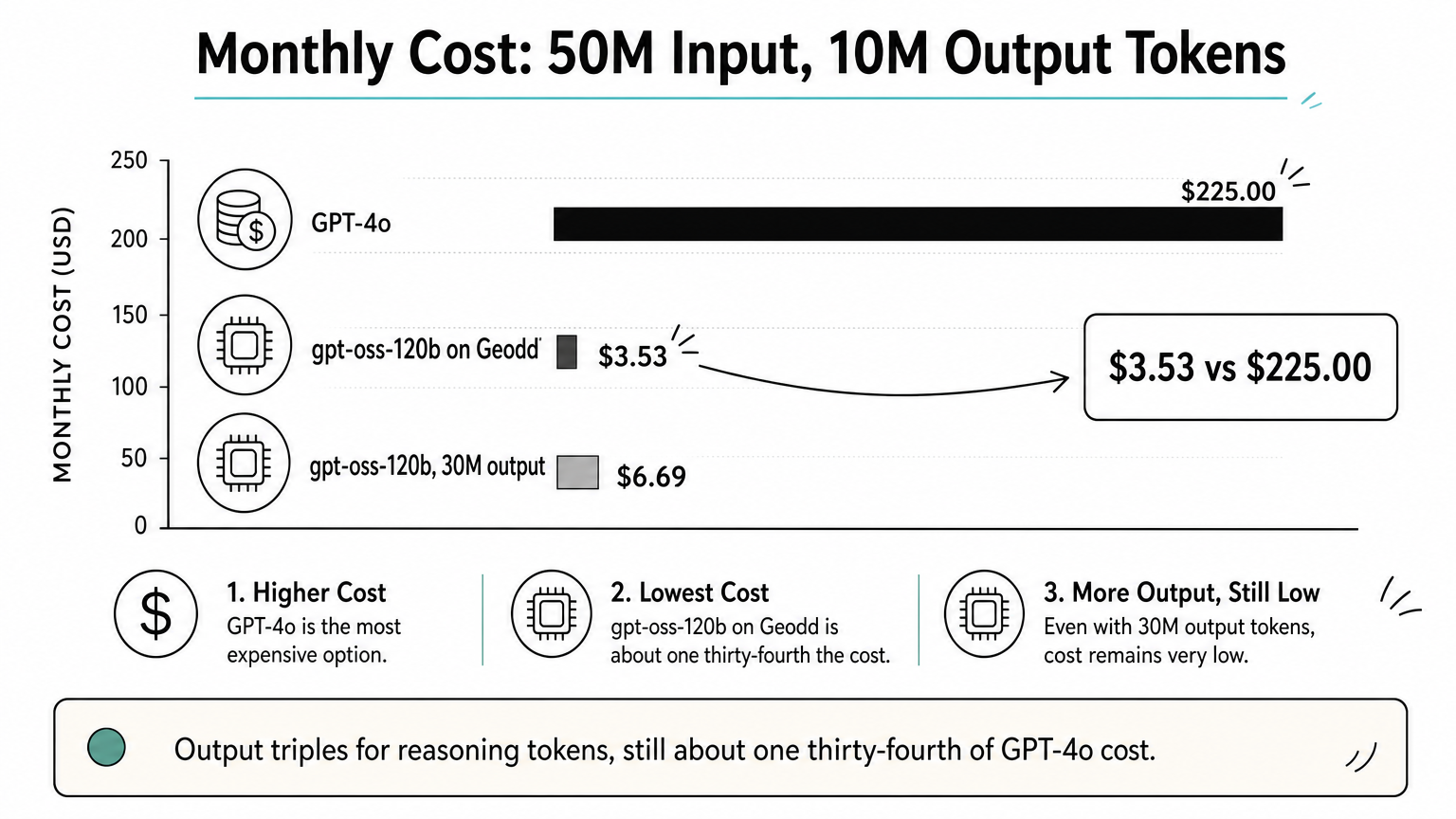
Take a typical app that sends 50M input tokens and 10M output tokens a month. On GPT-4o that is $125.00 plus $100.00, so $225.00. On gpt-oss-120b it is $1.95 plus $1.58, so $3.53. Reasoning models spend extra tokens thinking, so assume output triples to 30M. The bill becomes $1.95 plus $4.74, or $6.69, still about one thirty-fourth of the GPT-4o cost.
At typical volumes, gpt-oss-120b costs cents where GPT-4o costs dollars, even after reasoning tokens.
How to test both models on your own workload
Run the same 100 to 200 real prompts through both models, score the answers against a fixed rubric, and record latency and billed tokens. Public leaderboards rarely match your task, and a published production test shows why. On a fraud-classification agent, GPT-4o scored 77.41% accuracy against 70.24% for gpt-oss-120b, even though the open model was far cheaper.
Build a small eval set
A good eval set takes an afternoon. Follow these steps:

- Pull 100 to 200 real prompts from your logs, or write them to mirror production traffic.
- Write the expected answer or a pass/fail rubric for each one before you see any model output.
- Include your hardest cases and your most common ones, not only the easy middle.
- Score with code where you can (exact match, JSON validity, unit tests) and use a human or a judge model for the rest.
- Record the pass rate, median and 95th percentile latency, and billed input and output tokens per request.
Keep the set fixed, so you can rerun it whenever either model changes.
Run both models through one SDK
Because gpt-oss-120b on Geodd speaks the OpenAI API, one script can call both models. Copy the base URL and key from the model page.
import time
from openai import OpenAI

PROMPT = "Your test prompt here"

candidates = {
    "gpt-4o": OpenAI(api_key="OPENAI_KEY"),
    "openai/gpt-oss-120b": OpenAI(
        api_key="GEODD_KEY",
        base_url="BASE_URL_FROM_MODEL_PAGE",
    ),
}

for model, client in candidates.items():
    start = time.time()
    r = client.chat.completions.create(
        model=model,
        messages=[{"role": "user", "content": PROMPT}],
    )
    print(model, round(time.time() - start, 2), r.usage)
Compare billed output tokens, not only text length, because a reasoning model spends tokens before it answers. OpenAI notes you can set gpt-oss reasoning effort with one sentence in the system message. Test low effort first for latency-sensitive tasks.
Score both models on 100 real prompts before you trust any leaderboard, including this article's.
What benchmarks and speed tests show
On reasoning-heavy tasks gpt-oss-120b is the stronger model. On speed it depends on the host, and on strict structured extraction GPT-4o has held an edge in at least one published test.
Reasoning and general benchmarks
OpenAI reports that gpt-oss-120b reaches near-parity with o4-mini on core reasoning benchmarks, including competition coding, MMLU, and tool calling. OpenAI also says it beats GPT-4o on HealthBench. That is a vendor claim, so treat it as a signal, not a verdict.
GPT-4o is not a reasoning model, so the gap on competition math, multi-step logic, and hard coding problems is large. So yes, gpt-oss-120b is better than GPT-4o at reasoning. It is not better at everything, as the rest of this section shows.
Speed: tokens per second vs time to answer
Artificial Analysis measured gpt-oss-120b at high reasoning effort at 187.3 tokens per second against 134.0 for GPT-4o (Nov '24 version). Those numbers depend on the inference provider and its hardware, so your own measurement matters more.
Tokens per second is only half the story. A reasoning model thinks before its first visible token, so short answers can arrive later than their throughput suggests. The fraud-detection test above measured whole-request times on short yes/no calls:
| Model (host-specific prices) | Accuracy | Avg time | Median time | Price in/out per 1M |
|---|---|---|---|---|
| GPT-4o | 77.41% | 1.59s | 0.88s | $2.50 / $10.00 |
| gpt-oss-120b | 70.24% | 1.72s | 1.37s | $0.10 / $0.40 |
| gpt-oss-20b | 73.42% | 1.68s | 1.36s | $0.05 / $0.20 |
The gpt-oss prices there belong to the platform that ran the test, not to Geodd. Notice that the 20B model beat the 120B on this task, so bigger is not automatically better for narrow jobs.
Where GPT-4o still wins
A 2025 study of structured data extraction found GPT-4o achieved perfect schema coverage, while the open-weight models it tested reached 73% to 79% completeness. If your pipeline needs every field filled every time, test that behavior directly. Add JSON schema validation and a retry on failure, and the gap often narrows.
GPT-4o wins on steady formatting and multimodal input, while gpt-oss-120b wins on reasoning and price.
Capabilities and control, side by side
The two models overlap on tool use and structured outputs, and differ on input types, output limits, reasoning, and who controls the deployment.
| Capability | gpt-oss-120b | GPT-4o |
|---|---|---|
| License | Apache 2.0, open weights | Proprietary |
| Architecture | MoE, 117B total, 5.1B active | Not disclosed |
| Input | Text only | Text, images, audio |
| Context window | 128k native (131.07K tokens on Geodd) | 128K tokens |
| Maximum output | 131.07K tokens on Geodd | 16,384 tokens |
| Reasoning | Low, medium, high effort, visible chain of thought | None built in |
| Tool use, structured outputs | Supported | Supported |
| Self-hosting | Single 80 GB GPU | Not possible |
Output limits and reasoning behavior
The output limit is the underrated row. GPT-4o caps a single response at 16,384 tokens, while gpt-oss-120b on Geodd allows up to 131.07K. That matters for long code generation, full-document rewrites, and agents that write extended plans.
The reasoning trace needs handling. OpenAI warns that gpt-oss chain of thought may contain hallucinated or harmful content, so do not show it to end users. Strip it before display and log it only for debugging.
Data control and deployment
Open weights let you choose who runs the model, and where. On Geodd, gpt-oss-120b runs with zero data retention by default, and Geodd does not use API data for model training. For EU customers, Geodd hosts API inference in EU data center infrastructure by default. Check the model page for the regions available for this endpoint.
GPT-4o is available through OpenAI and Azure, so your options follow those vendors' terms. If you ship user-facing chat, add your own moderation layer with either model. Bind AI's comparison credits GPT-4o with tighter built-in moderation, while OpenAI says gpt-oss performs comparably to its frontier models on internal safety benchmarks.
Pick gpt-oss-120b when you need control over hosting and data, and GPT-4o when you need pixels or audio.
Which model fits which use case
Choose gpt-oss-120b for text-only, high-volume, reasoning-heavy, or privacy-sensitive workloads. Choose GPT-4o when images or audio are in the input, or when strict extraction accuracy beats cost.
Pick by workload
| Workload | Better fit | Why |
|---|---|---|
| Coding agents and multi-step tool use | gpt-oss-120b | Reasoning, long output limit, low token cost |
| High-volume summarization or classification | gpt-oss-120b, test 20B too | Cost dominates at volume |
| Screenshot, chart, or photo understanding | GPT-4o | gpt-oss-120b is text only |
| Voice and audio features | GPT-4o | Audio input is not supported by gpt-oss |
| Strict schema extraction, zero tolerance for gaps | GPT-4o, or gpt-oss with validation | Higher completeness in published testing |
| Data that must stay under your control | gpt-oss-120b | Open weights, zero data retention by default on Geodd |
Mixed setups and migration risk
You do not have to choose one. Route image requests to GPT-4o and text requests to gpt-oss-120b, then compare monthly cost and pass rate. If the 120B model is more than you need, try the smaller gpt-oss-20b for narrow, well-defined tasks.
GPT-4o is also an older model by now, so check OpenAI's deprecation notices before you build a long-lived product on it. Open weights remove that risk, because the model you tested keeps working for as long as someone hosts it.
Route by input type and task difficulty, and you rarely need to pay GPT-4o prices for text.
Pick the model your prompts prove
gpt-oss-120b is the stronger reasoner and costs about 60 times less per token. GPT-4o remains the choice for images, audio, and strictly formatted extraction. Neither claim replaces a test on your own data, and the test takes an afternoon.
If your workload is text, start with gpt-oss-120b and let GPT-4o prove it is worth the premium. You can run gpt-oss-120b through Geodd's OpenAI-compatible API, check token pricing and data handling on the model page, and switch your existing SDK code over by changing the base URL and model name.