The best AI models for coding 2026 depend on the job. Claude Opus 5.5 is the pick for the hardest multi-file work. GPT-6.1 Sol gives near-top scores at half Opus's price. Claude Sonnet 5.5 is the everyday driver, and DeepSeek V4.1 Flash or GLM 5.3 Flash win when token cost decides. A good pick scores well on agentic benchmarks such as SWE-bench Pro and Terminal-Bench, holds a long context, and costs little enough to run all day.
The problem is that new models ship every few weeks, and most scores are reported by the vendor. They also shift with the test harness. Sending every task to a frontier model burns budget fast, while picking the cheapest model on hype costs you in retries and review time.
This list ranks five models by published scores, listed prices, and what developers report from daily use. Geodd serves two of them, DeepSeek V4.1 Flash and GLM 5.3 Flash, through an OpenAI-compatible API, so their prices and limits come from our catalog. Closed-model prices are vendor list prices. A comparison table and a routing plan follow the five picks.
1. DeepSeek V4.1 Flash
DeepSeek V4.1 Flash is the best pick for most teams once cost counts, because its published scores sit next to the flagships at a fraction of the price.
Where it leads
On Terminal-Bench 2.1 it scores 90.6, above Claude Opus 5.5 at 87.6. Its DeepSWE v1.1 score of 74.2 ties Opus 5.5. The gap appears on the hardest tasks, where its Terminal-Bench 4.0 score is far lower than Opus's.
- Terminal-Bench 2.1: 90.6
- DeepSWE v1.1: 74.2
- Terminal-Bench 4.0: 31.2 (Opus 5.5: 66.4)
- Context: 1.05M tokens, with up to 384K output tokens
Flash matches the flagships on everyday agent work and trails them only when tasks get truly hard.
Cost and best fit
On Geodd it costs $0.30 per 1M input tokens and $1.10 per 1M output tokens. It runs from US-EAST with zero data retention by default. Because the API is OpenAI-compatible, switching means changing the base URL and the model ID (deepseek-ai/DeepSeek-V4.1-Flash).
It suits high-volume coding agents, review bots, and repository-wide refactors. Send only the rare, hardest tasks to a frontier model. You can check limits and SDK examples on the DeepSeek V4.1 Flash API page.
2. Claude Opus 5.5
Opus 5.5 is the strongest pick when a wrong answer costs more than the tokens.

Where it leads
Opus 5.5 posts 89.9 on SWE-bench Pro, up from 69.2 for Opus 4.8. That is the largest jump of any model on the list. It also scores 87.6 on Terminal-Bench 2.1 and 74.2 on DeepSWE v1.1. Developer threads keep the same advice: Opus for the tough, complicated tasks.
- SWE-bench Pro: 89.9
- Terminal-Bench 2.1: 87.6
- Terminal-Bench 4.0: 66.4
- Context: 1M tokens
Opus earns its price on planning and review, where one bad decision spreads into every file that follows.
Cost and best fit
List price is $4 per 1M input and $20 per 1M output tokens, below the $5 and $25 that Opus 4.8 carried. It is still the most expensive pick here.
Use it as a planner and reviewer. It fits architecture decisions, framework migrations, and hard debugging across dozens of files. Hand the writing of routine code to a cheaper model.
3. GPT-6.1 Sol
GPT-6.1 Sol is the pick when you want top-tier results at Sonnet-level prices.
Where it leads
Its clearest evidence is a head-to-head on DeepSWE v1.1, where it scores 75.2 against 74.2 for Opus 5.5. It also offers a 1M-token context. It has fewer published scores than the other picks, so one benchmark win is not proof it beats Opus everywhere.
- DeepSWE v1.1: 75.2
- Context: 1M tokens
- Strongest evidence: one head-to-head against Opus 5.5
One benchmark lead at half the price is a reason to test GPT-6.1 Sol on your repo, not a reason to switch blindly.
Cost and best fit
List price is $2 per 1M input and $10 per 1M output tokens, half of Opus 5.5. Developers have long favored OpenAI models inside Codex for scoping and test generation, so test it there first.
It suits teams already on the OpenAI stack that want a frontier planner without Opus's bill. Run your own 20 tasks before you commit.
4. Claude Sonnet 5.5
Sonnet 5.5 is the best everyday coding model, because it covers most of Opus's results for half the price.
Where it leads
Opus keeps the lead on SWE-bench Pro, 89.9 against 81.3, and on Terminal-Bench 2.1, 87.6 against 83.2. On the hardest terminal tasks the order flips. Sonnet 5.5 scores 70.6 on Terminal-Bench 4.0 against Opus's 66.4. Reddit threads call Sonnet the model for everyday coding.
- SWE-bench Pro: 81.3
- Terminal-Bench 2.1: 83.2
- Terminal-Bench 4.0: 70.6
- Context: 1M tokens
Sonnet 5.5 gives up a few points to Opus on one benchmark and wins on another, at half the cost.
Cost and best fit
List price is $2 per 1M input and $10 per 1M output tokens. It is the safest default for an IDE assistant or a terminal agent, where you make many calls a day and want reliable multi-file edits. Pair it with Opus for planning and you cover most workflows.
5. GLM 5.3 Flash
GLM 5.3 Flash is the cheapest pick here that still handles real agent work.

Where it leads
Its Terminal-Bench 2.1 score of 84.3 is close to Sonnet 5.5's 83.2. It is built for coding agents, repository-scale debugging, and tool-using workflows. It also reads screenshots, charts, and documents, which most cheap coding models cannot do. Public rankings place it a tier below DeepSeek V4.1 Flash overall, so use it for well-scoped work.
- Terminal-Bench 2.1: 84.3
- Context: 1.05M tokens
- Maximum output: 128K tokens
- Input types: text plus screenshots and charts
GLM 5.3 Flash is the model to give your sub-agents and bulk jobs, not your hardest architecture questions.
Cost and best fit
On Geodd it costs $0.11 per 1M input and $0.40 per 1M output tokens. It runs from US-EAST with zero data retention by default. The model ID is zai-org/glm-5.3-flash.
It fits parallel sub-agents, bulk edits, test-writing, and screenshot-to-code tasks. Check the GLM 5.3 Flash API page for streaming and structured-output details.
How the five compare on price and score
Cost is where the picks separate most, even when scores are close. The table uses a worked example of 50M input and 10M output tokens a month, a realistic load for a small team running coding agents.
Side-by-side scores and monthly cost
| Model | Price per 1M (in / out) | Terminal-Bench 2.1 | DeepSWE v1.1 | Monthly cost |
|---|---|---|---|---|
| DeepSeek V4.1 Flash (Geodd) | $0.30 / $1.10 | 90.6 | 74.2 | $26.00 |
| Claude Opus 5.5 | $4 / $20 | 87.6 | 74.2 | $400.00 |
| GPT-6.1 Sol | $2 / $10 | not published | 75.2 | $200.00 |
| Claude Sonnet 5.5 | $2 / $10 | 83.2 | not published | $200.00 |
| GLM 5.3 Flash (Geodd) | $0.11 / $0.40 | 84.3 | not published | $9.50 |
| GPT-OSS-120B (Geodd) | $0.039 / $0.158 | not published | not published | $3.53 |
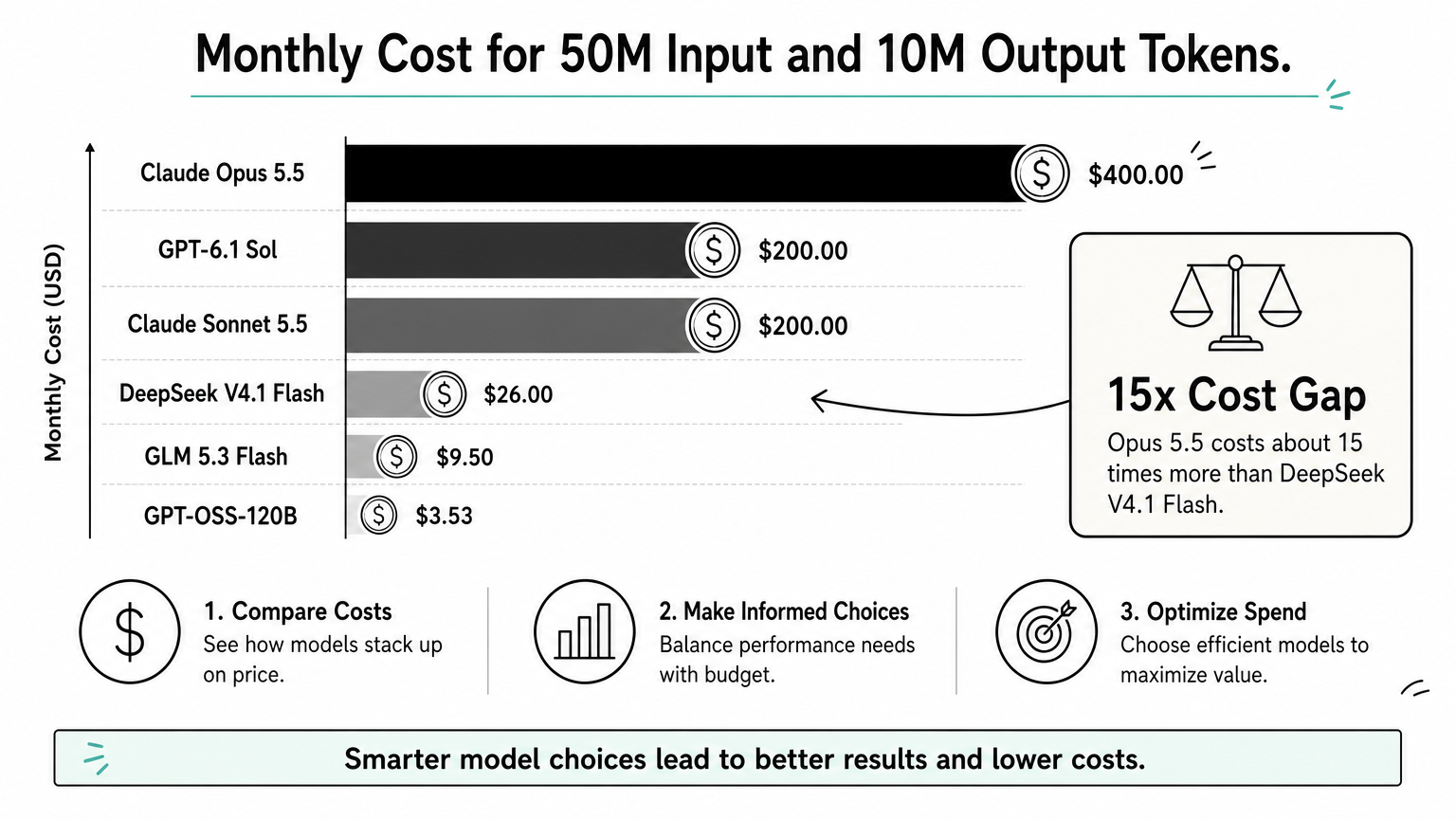
The same workload costs $26 on DeepSeek V4.1 Flash and $400 on Opus 5.5, about 15 times more. Treat gaps of two or three points as ties, because scores shift with the test harness and many are vendor-reported.
Runners-up worth testing
Gemini 4 Argon lists at $2 and $10 per 1M tokens with a 1M context. Its DeepSWE v1.1 score is 77.9, above every pick here, but it posts 57.4 on Terminal-Bench 4.0. Kimi K3 costs $3 and $15 and scores 88.3 on Terminal-Bench 2.1.
GPT-OSS-120B is OpenAI's open-weight model for reasoning, function calling, and structured outputs. Its context is 131.07K tokens, shorter than the others. It is the budget floor, and the GPT-OSS-120B API page lists its regions and data handling. "Free" here means no per-token fee if you self-host the weights, but you still pay for GPUs.
How to route work across models
No single model should do every job. A split by stage keeps quality high and bills low:
- Plan and review with Opus 5.5 or GPT-6.1 Sol.
- Do daily multi-file edits with Sonnet 5.5.
- Run bulk execution, tests, and sub-agents on DeepSeek V4.1 Flash or GLM 5.3 Flash.
- Escalate to the planner model when a cheap model fails twice.
Pay frontier prices for the decisions and budget prices for the typing.
Pick by task, then test on your own repo
The best AI model for coding in 2026 is a small set of models, not one. Opus 5.5 handles the hardest reasoning. GPT-6.1 Sol and Sonnet 5.5 cover daily work at half the price. DeepSeek V4.1 Flash and GLM 5.3 Flash cut the bill by an order of magnitude while keeping scores close on everyday tasks.
Benchmarks only narrow the field. Run 20 real tasks from your own codebase through two or three models, count retries, and compare the cost per merged change. To try the open-weight picks behind one OpenAI-compatible API, compare coding models in the Geodd catalog.