The best DeepSeek alternative depends on what you use it for. ChatGPT is the safest all-rounder, Claude is the strongest pick for coding agents, and Gemini wins when your inputs include images, audio or video. Qwen and Llama suit you if you want open weights you can host yourself. If you want open models behind the OpenAI SDK with zero data retention by default, a hosted API such as Geodd fits. Grok and Mistral cover live information and European deployment.
Most people start searching for an alternative because of friction, not hype. Common triggers are slow or unavailable service at peak hours, questions about where prompts are processed, weak support for images and video, thinner tooling than the large US providers, and no live web access. DeepSeek is still very cheap per token, so the goal is not to find a model that beats it everywhere. It is to find the one that removes your specific problem without wrecking your budget.
Geodd is an AI inference company that has operated since 2023, and it is listed first because this is our blog. We kept its section as factual as the others. Below you get eight options for chat, open-source, API and coding use, each with what it offers, what it costs and where it falls short. After the list you will find a needs-to-pick table, a worked cost example and the code to move an app off the DeepSeek API.
1. Geodd: open models through one OpenAI-compatible API
Pick Geodd if you want cheap, capable open models but want to change who serves them. It hosts GLM 5.3 Flash, GPT-OSS-120B, DeepSeek V4.1 Flash and Kimi K2.6 behind an OpenAI-compatible API, so most apps switch by changing a base URL. It is built for developers and teams who need an API, not a chat window.
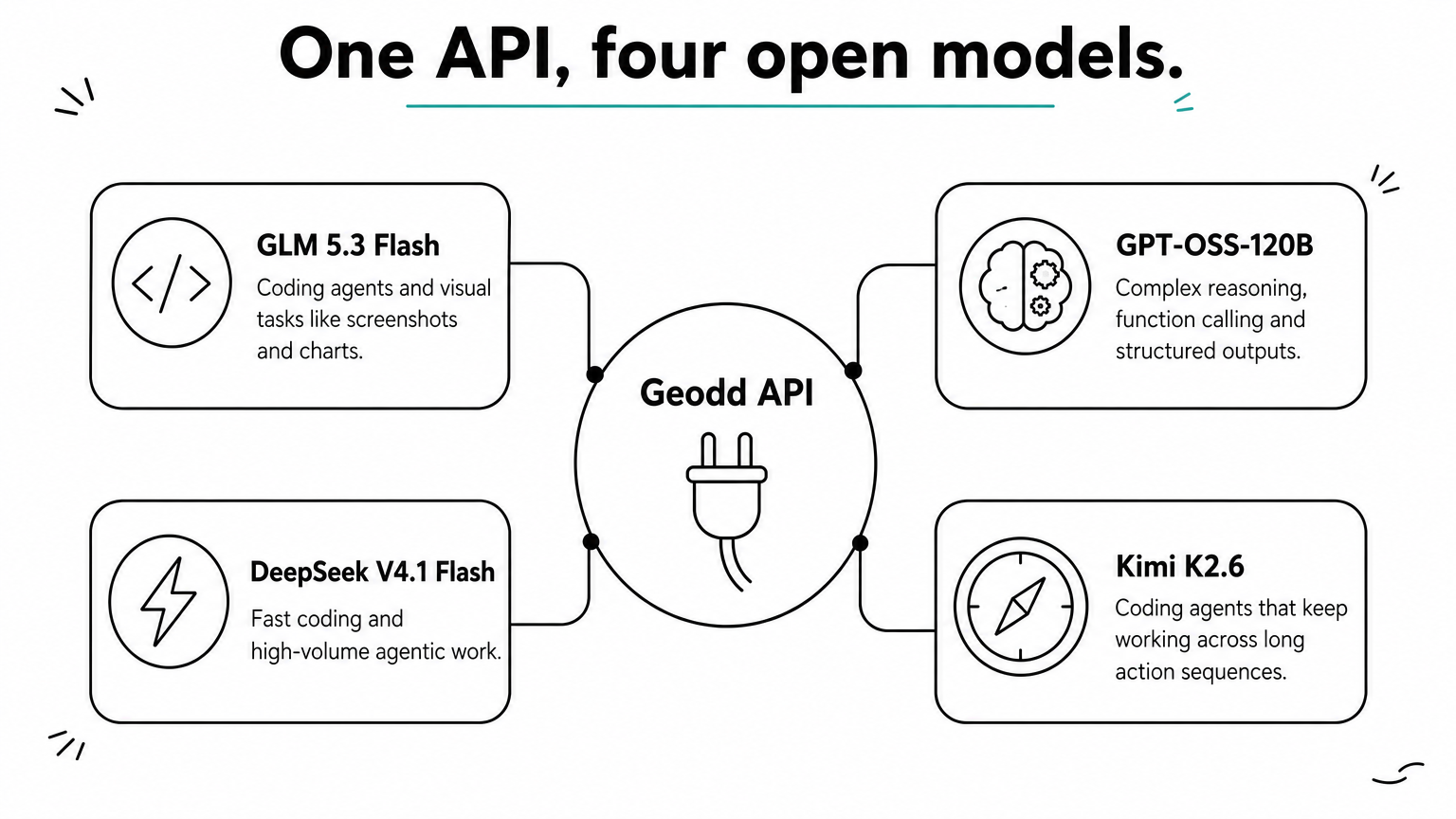
Geodd is an API choice: you pick the model, keep your OpenAI SDK code and get zero data retention by default.
What it offers
Serverless inference priced per token and dedicated GPU deployments both run through one SDK. On privacy, Geodd applies zero data retention by default, does not use API data for model training, and does not store prompts, outputs or uploaded files unless you agree otherwise in writing. EU customers get API inference hosted in EU data center infrastructure by default, and the company is GDPR ready with SOC 2 compliance pending.
The four text models most relevant to a DeepSeek switch:
- GLM 5.3 Flash: coding agents, repository-scale debugging, tool-using workflows, and visual tasks such as screenshots, charts and documents.
- GPT-OSS-120B: OpenAI's higher-capability open-weight model for complex reasoning, function calling and structured outputs.
- DeepSeek V4.1 Flash: fast coding, software-engineering agents and high-volume agentic work that still needs strong reasoning.
- Kimi K2.6: coding-heavy agents that must keep working across long sequences of actions.
Pricing and access
Prices below are per million tokens, and each model has its own page with SDK examples and integration details. Keep versions distinct when you compare: DeepSeek V4.1 Flash is not the same model as DeepSeek V4 Flash.
| Model | Input | Output | Context | Max output | Region |
|---|---|---|---|---|---|
| GPT-OSS-120B | $0.039 | $0.158 | 131.07K | 131.07K | See model page |
| GLM 5.3 Flash | $0.110 | $0.400 | 1.05M | 128K | US-EAST |
| DeepSeek V4.1 Flash | $0.300 | $1.100 | 1.05M | 384K | US-EAST |
| Kimi K2.6 | See model page | See model page | 262.14K | 262.14K | US-EAST |
Limits to know
Geodd is an inference provider for developers, so it does not replace a chat interface for non-technical users. DeepSeek's own list price for V4 Flash, reported at $0.14 input and $0.28 output per million tokens, is lower than Geodd's price for V4.1 Flash. You choose Geodd for data handling, regions and one provider across several models, not for the cheapest DeepSeek token.
Check capabilities model by model. Streaming, tool calling and region availability differ between endpoints, even from the same provider.
- Choose it when: you need an OpenAI-compatible API, zero data retention and a way to compare several open models on one bill.
- Look elsewhere when: you want a consumer chatbot, or the lowest possible DeepSeek token price.
2. ChatGPT and GPT-5.6: the safest all-rounder
ChatGPT is the default alternative when you want a polished chat app and the largest developer ecosystem from one vendor. It is best for general work, coding with tools and teams that want mature SDKs. OpenAI's GPT-5.6 family comes in three tiers, Sol, Terra and Luna, and runs in ChatGPT, Codex and the OpenAI API.
GPT-5.6 is the pick when ecosystem and reliability matter more than the lowest token price.
What it offers
The tiers let you route by difficulty. Send simple jobs to the cheap tier and keep the flagship for hard problems. The API also supports programmatic tool calling and multi-agent workflows, and Codex handles coding tasks.
- Complex reasoning and research
- Coding and agentic workflows
- Tool calling and computer-use tasks
- A deep library of integrations, tutorials and community answers
Pricing and access
ChatGPT gives free access to selected models, which is enough to test it on your own prompts. Paid plans lift the usage limits.
On the API, OpenAI cut GPT-5.6 Luna to $0.20 per million input tokens and $1.20 per million output tokens in July 2026. The flagship Sol is priced at $5 input and $30 output. Check OpenAI's pricing page before you commit, because model names and rates change often.
Limits to know
The weights are closed, so you cannot self-host. Price is the other gap. Luna's output rate is more than four times DeepSeek V4 Flash's $0.28, and Sol sits far above it.
- Choose it when: you want one vendor for chat, coding and agents, with strong tooling.
- Look elsewhere when: you run output-heavy pipelines on a tight budget, or you need open weights.
3. Claude: best for coding agents and long documents
Claude is the strongest alternative when your DeepSeek work is software development or long-document analysis. Anthropic's current Sonnet generation, Claude Sonnet 5, is available in the Claude app, Claude Code and the Claude Platform API.
If correctness across many files matters more than token price, Claude is the first model to test.
What it offers
Claude is built for work that goes beyond writing one function from a prompt. It explores repositories, edits several files, debugs, uses tools over many steps and holds context across long sessions. Teams also use it to review contracts, compliance records and technical documentation.
- Repository exploration and multi-file changes
- Code review, planning and debugging
- Long-document and contract analysis
- Long-running agent tasks that call tools
Pricing and access
The Claude app offers free consumer access with usage limits. That is enough to check whether it handles your codebase better than DeepSeek does before you pay for anything.
On the API, Anthropic launched Sonnet 5 with introductory pricing through August 31, 2026 and announced a standard price of $3 per million input tokens and $15 per million output tokens afterward. Confirm the current rate on Anthropic's pricing page.
Limits to know
Claude is considerably more expensive than DeepSeek, and for high-volume pipelines that gap is hard to ignore. It also has closed weights and limited real-time web retrieval.
- Choose it when: you work with large repositories, rely on autonomous coding agents or need strict instruction following.
- Look elsewhere when: cost per call decides the project, or you must host the model yourself.
4. Gemini: best for images, video and Google tools
Gemini is the alternative to choose when your input is not mostly text. Google's models handle text, images, audio, video and documents natively, and Gemini 3.7 Flash is described by Google as built for agentic workflows and multimodal reasoning. It also plugs into the Google ecosystem you may already use.
If screenshots, video or Drive files are central to your product, Gemini fits better than a text-first model.
What it offers
Gemini can read a screenshot of a bug, summarize a long recording or cross-check documents without a separate transcription step. Search grounding lets answers draw on Google's index, and Workspace integration brings it into Docs, Sheets and Gmail.
- Screenshot, chart and document understanding
- Video and audio analysis
- Search-grounded answers
- Multimodal agents built on Google's ecosystem
Pricing and access
Google offers a free Gemini tier in the app, so you can test it on real files at no cost. Paid plans raise usage limits.
For developers, Google keeps free API access to selected Gemini models for development and small projects. Paid tiers add the higher limits and production features. Check Google's current pricing page, since Flash model rates have changed through promotions.
Limits to know
Gemini is a closed model with some features tied to Google's infrastructure. For pure high-volume text work, DeepSeek's per-token price is very hard to match.
- Choose it when: multimodal data or Google Workspace integration is central to the job.
- Look elsewhere when: your workload is plain text at scale, or you need open weights.
5. Grok: best for live news and social data
Grok is the alternative for questions about what is happening now. xAI's assistant connects to the web and to X, and it offers an API for developers. It is best for trend tracking, news research and sentiment checks.
Grok earns its place on freshness, not on coding depth.
What it offers
DeepSeek answers from its training data unless you add search. Grok pulls current conversations and news into its answers, which helps with market monitoring and public-sentiment questions. You can ask follow-up questions and explore a topic as it develops.
- Trending topics and breaking news
- Social sentiment and discussion analysis
- Current-events research
- Fast conversational exploration
Pricing and access
Grok is available in a consumer chat experience tied to the X platform, and xAI offers API access for developers. I do not quote a price here because plans and rates change, so check xAI's current plans for free access and token pricing.
Treat any free allowance as a test tool. Run it on the same live-information questions you currently send to DeepSeek and compare the answers for freshness and sourcing.
Limits to know
Grok is less suited to coding-heavy work than Claude or GPT-5.6, and its answers lean on social data, which can be noisy. Its developer ecosystem is smaller than the big three.
- Choose it when: your questions depend on current events or online conversation.
- Look elsewhere when: you need coding agents, structured pipelines or open weights.
6. Qwen: best open-weight DeepSeek alternative
Qwen is the closest like-for-like swap if you picked DeepSeek for open models. The Qwen family spans reasoning, coding and general-purpose models in multiple sizes, with open weights you can download, plus a hosted API. It suits developers who want strong results without depending on one closed provider.
Qwen gives you DeepSeek's openness with a wider range of model sizes.
What it offers
Because you can run Qwen on your own hardware, it works for private deployments, offline use and fine-tuning on your own data. Smaller variants fit modest GPUs, which matters when a frontier-scale model would be overkill. Multilingual applications are another common use.
- Local inference and private infrastructure
- Coding and reasoning tasks
- Fine-tuning on proprietary data
- Multilingual and cost-sensitive products
Pricing and access
Downloading the weights is free, but free weights are not free compute. You pay for GPUs, electricity and the engineering time to serve the model.
If you only want an endpoint, Qwen is also offered through hosted APIs, and reviewers describe its price-to-performance as strong. Compare the hosted rate with DeepSeek's before assuming you will save money.
Limits to know
Licenses vary between Qwen versions, so read the exact license before shipping a commercial product. A hosted DeepSeek endpoint is also easier to run than a self-managed one.
- Choose it when: open weights and deployment control matter almost as much as quality.
- Look elsewhere when: you want the cheapest hosted API with zero infrastructure work.
7. Llama: best for self-hosting and fine-tuning
Llama is the choice when you want complete control of the model and the data path. Meta's open-weight models run locally, in your cloud or on rented GPUs, and they have the largest open ecosystem of tools around them. It is best for private deployments, offline use and custom fine-tuning.
Llama's advantage is the ecosystem around it, not a guaranteed win over DeepSeek on raw quality.
What it offers
Local runtimes, quantization tools, fine-tuning frameworks, GPU providers and cloud inference services all support Llama. That means you can start on a laptop, move to a rented GPU and later scale to a cluster without changing models. Your prompts never have to leave infrastructure you control.
- Local and offline inference
- Full control over data and deployment
- Custom fine-tuning on your own data
- A wide choice of model sizes and quantizations
Pricing and access
The weights are free to download, so your cost is hardware. A dedicated GPU rental is the middle path if you want to self-manage the software without buying servers, and several providers also offer Llama as a pay-per-token API.
Budget for the full stack, not only the GPU. Inference software, scaling, monitoring and on-call time all count toward the total cost of self-hosted inference.
Limits to know
Self-hosting makes you responsible for uptime and tuning. Out-of-the-box quality varies by model size, and Meta's license has terms you should read before commercial use.
- Choose it when: privacy, fine-tuning or avoiding vendor lock-in outweigh convenience.
- Look elsewhere when: you want a managed endpoint and no infrastructure work.
8. Mistral: best for European deployment
Mistral is the alternative for teams that care where AI runs. The French company offers commercial AI services and open models, plus the Le Chat assistant, which makes it a fit for European organizations and enterprise deployments. It is best for data-control requirements and flexible hosting.
Mistral wins on deployment questions such as where the model runs, not on cheapest tokens.
What it offers
Mistral gives you a choice between its hosted services and models you can run yourself. That flexibility helps when legal, procurement or compliance teams have views about infrastructure location. Internal assistants and private deployments are typical uses.
- European infrastructure and enterprise AI
- Private deployments and self-hosting with open models
- Internal applications with data-control rules
- Everyday chat through Le Chat
Pricing and access
Le Chat has a free plan, so you can try the assistant before you buy. Paid tiers raise the limits.
For developers, Mistral sells API access, and some of its models are open while others are not. Check the license and the access terms for the exact model you plan to use.
Limits to know
DeepSeek is cheaper when your only question is how cheaply you can call a capable model. Mistral's strengths show up when infrastructure and compliance questions matter more than a fraction of a cent per request.
- Choose it when: European hosting or deployment flexibility is on your requirements list.
- Look elsewhere when: you are optimizing for token price or multimodal range.
How to choose the right DeepSeek alternative
Start with your hardest constraint, then pick from the models that satisfy it. Budget, openness, privacy and the kind of input usually narrow eight options to two or three. Then test those on your own prompts.
One constraint decides most of the choice: free access, open weights, an API, coding strength or data location.
Match the pick to your constraint
| Your constraint | Strong picks | Why |
|---|---|---|
| Free chatbot | ChatGPT, Gemini, Claude, Le Chat | Free tiers with usage limits |
| Open source or self-hosting | Qwen, Llama, GPT-OSS-120B, some Mistral models | Weights you can download and run |
| Hosted API | Geodd, OpenAI, Anthropic, Google, Mistral | Per-token billing, SDKs |
| Coding | Claude, GPT-5.6, Kimi K2.6, GLM 5.3 Flash, DeepSeek V4.1 Flash | Repository work and tool use |
| Images, video, audio | Gemini | Native multimodal input |
| Live information | Grok | Web and X access |
| EU data location | Mistral, self-hosted Llama or Qwen, Geodd | European hosting options |
What a typical API workload costs
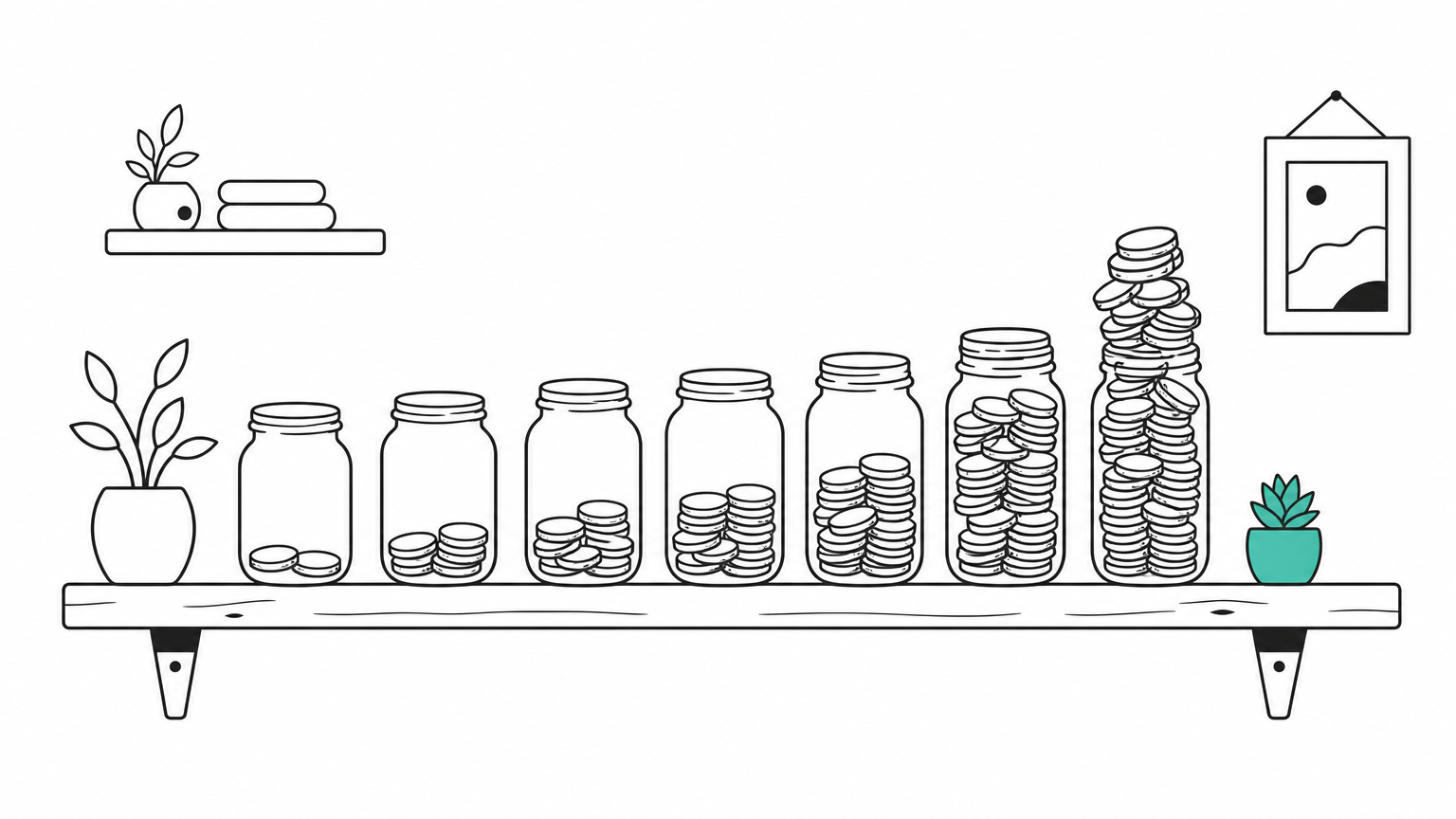
Token prices look tiny until you multiply them. This example uses a workload of 50 million input tokens and 10 million output tokens a month, with prices as reported in mid-2026 and no caching discounts. Verify current rates before you budget.
| Model | Input / Output per 1M | Monthly cost |
|---|---|---|
| GPT-OSS-120B (Geodd) | $0.039 / $0.158 | $3.53 |
| GLM 5.3 Flash (Geodd) | $0.110 / $0.400 | $9.50 |
| DeepSeek V4 Flash (DeepSeek API) | $0.14 / $0.28 | $9.80 |
| GPT-5.6 Luna | $0.20 / $1.20 | $22.00 |
| DeepSeek V4.1 Flash (Geodd) | $0.30 / $1.10 | $26.00 |
| Claude Sonnet 5 (standard price) | $3 / $15 | $300.00 |
| GPT-5.6 Sol | $5 / $30 | $550.00 |
The spread is the point. GLM 5.3 Flash lands within a few cents of DeepSeek V4 Flash, while Claude costs about 30 times as much and Sol about 58 times as much. Whether that premium is worth it depends on how often the cheaper model fails your task.
When staying with DeepSeek still makes sense
DeepSeek keeps real advantages. Its API pricing is extremely low, its V4 models list a 1M-token context, and the API supports tool calls and JSON output in OpenAI-compatible and Anthropic-compatible formats. If your app already works reliably, switching because another model won a benchmark can add cost and risk for no user benefit.
A better move is often partial. Route the workloads where another model clearly wins, and keep DeepSeek for the tasks where its economics are best.
How to switch from the DeepSeek API without a rewrite
Moving between OpenAI-compatible APIs usually means changing three values: the base URL, the API key and the model name. Your prompts, message format and most SDK code stay the same. The real work is testing that the new model behaves well on your tasks.
Changing the endpoint takes minutes. Proving the new model works on your tasks is the real job.
Change the client settings
Here is the pattern with the OpenAI Python SDK, using GLM 5.3 Flash's model ID as the example. Take the base URL from your provider's model page, since it is not the same everywhere.
from openai import OpenAI

client = OpenAI(
    base_url="YOUR_PROVIDER_BASE_URL",
    api_key="YOUR_API_KEY",
)

response = client.chat.completions.create(
    model="zai-org/glm-5.3-flash",
    messages=[
        {"role": "user", "content": "Explain this stack trace and suggest a fix."}
    ],
)

print(response.choices[0].message.content)
Keep the model name in an environment variable. That makes the switch, and any rollback, a configuration change instead of a code change.
Test on your own tasks first
LLM benchmarks rarely match your workload, so build a small evaluation before you move traffic. Follow these steps:
- Collect 30 to 50 real prompts, including easy requests, long contexts, tool calls and structured-output cases.
- Run the same set against DeepSeek and two or three candidates.
- Record success rate, latency, retries and cost for each.
- Divide total spend by successfully completed tasks to get cost per successful outcome.
- Check streaming, tool calling and structured-output support for each model, since they differ between endpoints.
- Move traffic gradually, starting with the workload where the new model wins by the widest margin.
The cheapest token is not always the cheapest result. A model that needs retries or produces code you must repair can cost more per finished task than a pricier one.
Choosing your DeepSeek replacement
No single model replaces DeepSeek everywhere. ChatGPT is the safest general pick, Claude leads for coding agents, Gemini handles images and video, Grok brings live data, Qwen and Llama give you open weights, and Mistral suits European deployment. DeepSeek still wins on raw API price, so many teams end up routing different tasks to different models.
Decide by constraint, price your real token volume, and run a small test before you switch. If an OpenAI-compatible API with zero data retention by default fits your project, you can compare model pricing and try the API on Geodd to see which open model handles your workload at the lowest cost.