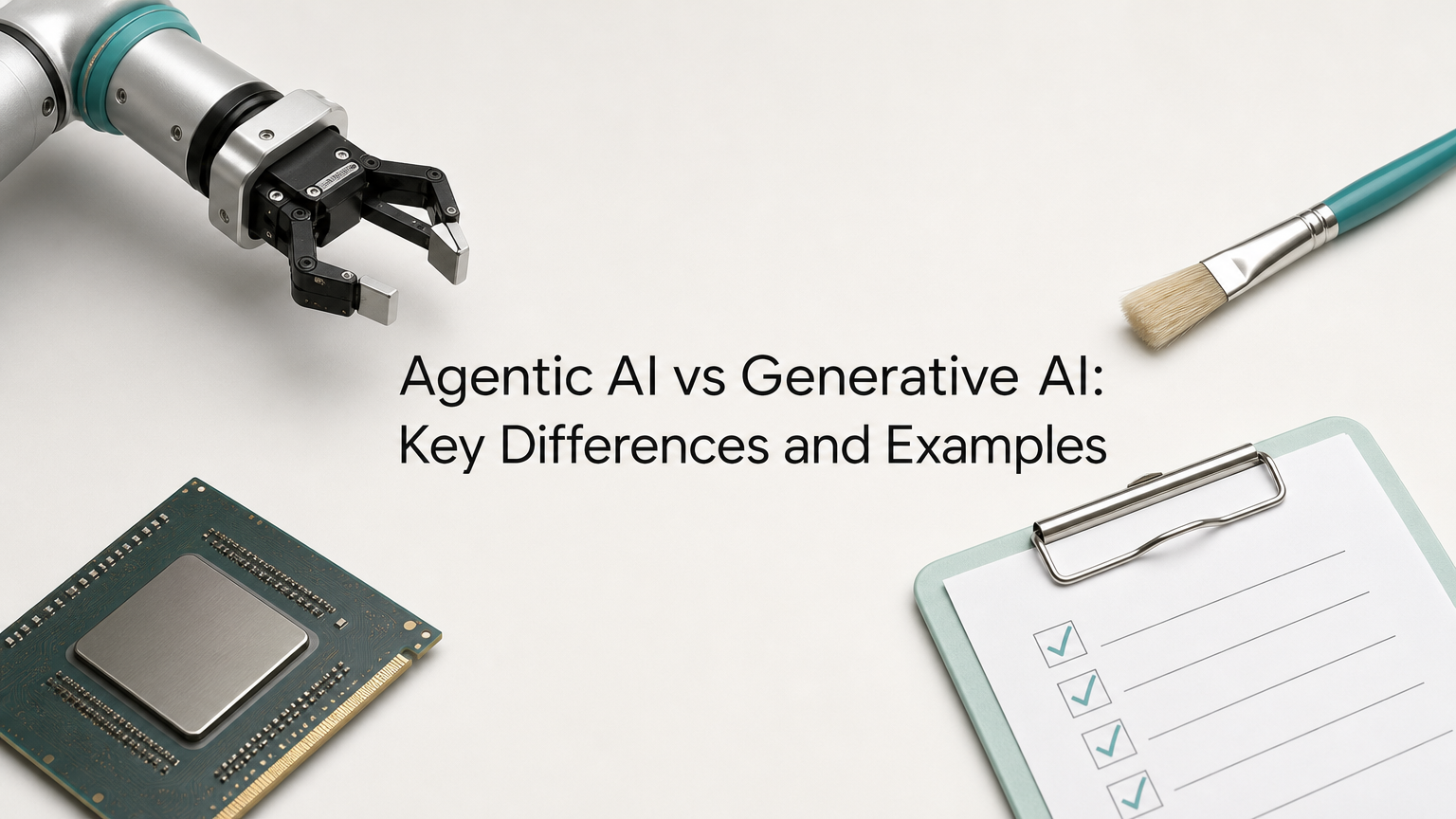
Agentic AI versus generative AI comes down to output versus outcome. Generative AI creates content such as text, code, images, or summaries when you prompt it. Agentic AI uses a generative model as its reasoning engine, then plans, calls tools, checks the results, and keeps going until a goal is met. Generative AI answers. Agentic AI acts.
Predictive AI is the third term people mix in, and it is the oldest of the three. It scores or forecasts from historical data, like a fraud score or a demand forecast. Traditional AI is the broader label for the rule-based and machine learning systems built before generative models. The terms are not rivals, because most agents contain a generative model.
At Geodd we run inference for both kinds of workload, so we see where the line blurs in production. This article shows how the three types differ, how to choose between them, what real examples look like, and what an agent demands from the model API underneath it.
Why the difference matters when you build or buy
The difference matters because it decides what you build, what it costs, and how much can go wrong. Generative AI produces something for a person to review. Agentic AI takes steps on its own, so a mistake can spread before anyone looks.
Generative AI hands you a draft, agentic AI hands you a result, and each one needs a different level of oversight.
The three types side by side
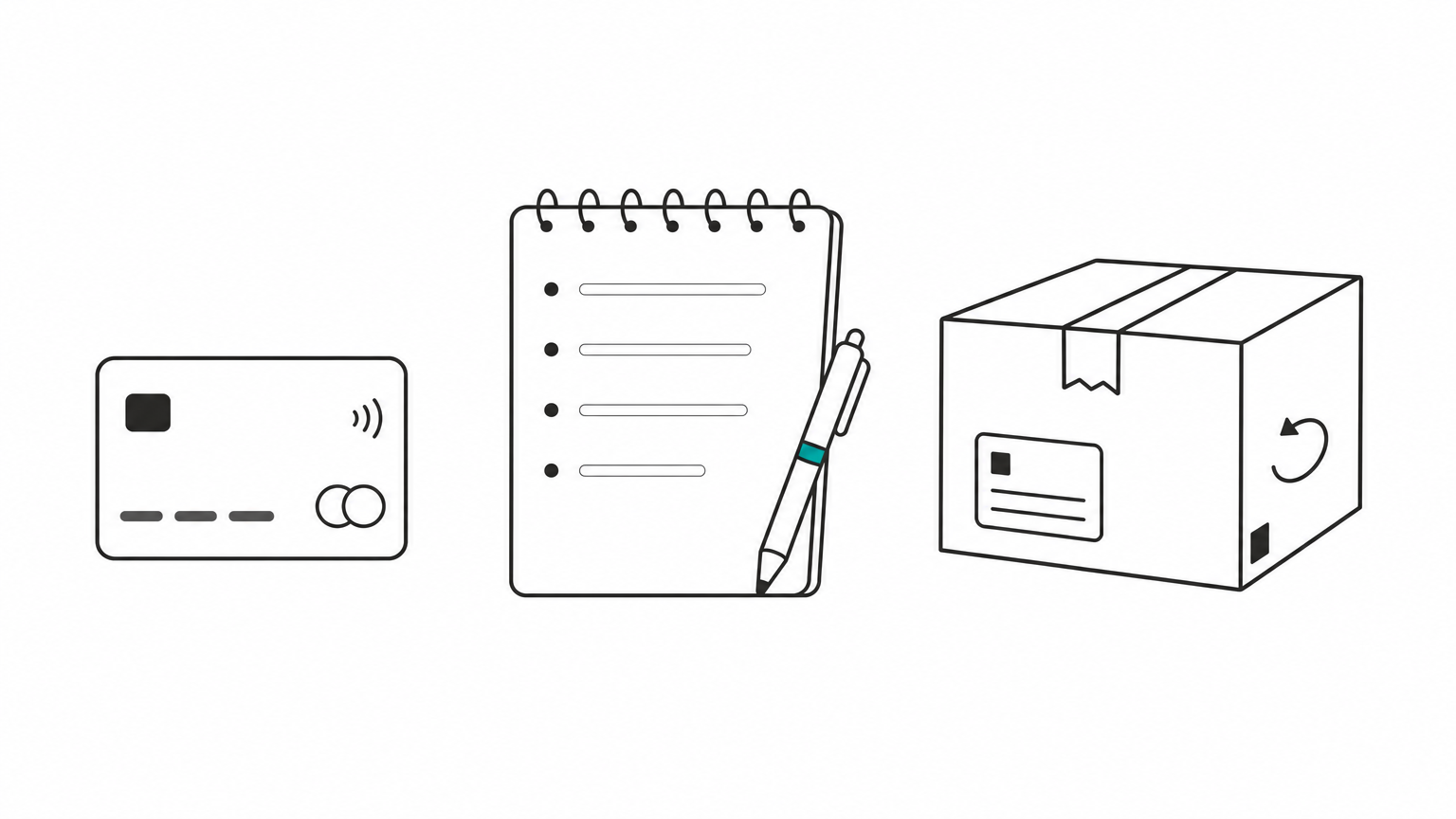
The difference between generative AI and agentic AI is easiest to see next to predictive AI, the older approach often called traditional AI. Predictive systems estimate, generative systems create, and agentic systems pursue a goal.
| Traditional or predictive AI | Generative AI | Agentic AI | |
|---|---|---|---|
| Core job | Predict or classify from past data | Create content from a prompt | Complete a goal across several steps |
| How it runs | One model pass per input | One inference per prompt | A loop of inferences, tool calls, and checks |
| Output | A score, label, or forecast | Text, code, image, or audio | A finished task or a changed system |
| Human role | Reads the score | Reviews the draft | Sets goals and limits, approves risky actions |
| Example | Fraud score on a card payment | Drafting a product description | Resolving a refund request end to end |
Under the hood, agents run a loop. They read the goal, plan, choose a tool, act, observe the result, and decide the next step. Each pass is another model call, so an agent is slower and costlier than a single prompt.
You may also see the four types of AI listed: reactive machines, limited memory, theory of mind, and self-aware. That list sorts systems by capability, which is a different axis from this comparison. Only the first two exist in practice today.
What confusing them costs you
Teams that buy an agent for a drafting job pay for loops they never needed. Teams that expect a chatbot to finish a workflow end up copying and pasting between tabs. The first mistake wastes money, and the second wastes time.
Risk differs too. A bad generative answer is a bad draft. A bad agent action can send an email, change a record, or spend money. Agentic systems need permissions, logs, and approval gates, while generative tools mostly need review.
How to choose between generative and agentic AI
Choose generative AI when a person will use the output. Choose agentic AI when the task needs several dependent steps and outside tools. Neither is better in general, so the honest answer to "is agentic AI better?" is that they solve different jobs, and most teams should start generative and add agency later.
Start with a single generative call, and add agency only where fixed steps cannot do the job.
A four-question decision test
Run your task through these questions before you pick an approach.
- Does the task end with content or with a changed system? Content points to generative AI.
- Can you write the steps in advance? Fixed steps point to a plain workflow that calls a model at set points. Unknown steps point to an agent.
- What does a wrong action cost? If the cost is high, keep a human approval step.
- Does the task need data from outside the prompt? If so, you need tool calling, which is the first building block of an agent.
A "fixed steps" answer to question two is the most common result. A workflow with a generative model inside is cheaper and easier to test than an agent, and it covers many cases that people label agentic.
Worked example: what one agent run costs
Take GLM 5.3 Flash on Geodd, priced at $0.110 per 1M input tokens and $0.400 per 1M output tokens. An agent resends its growing history on every step, so input tokens pile up fast. The token counts below are illustrative, so measure your own traffic.
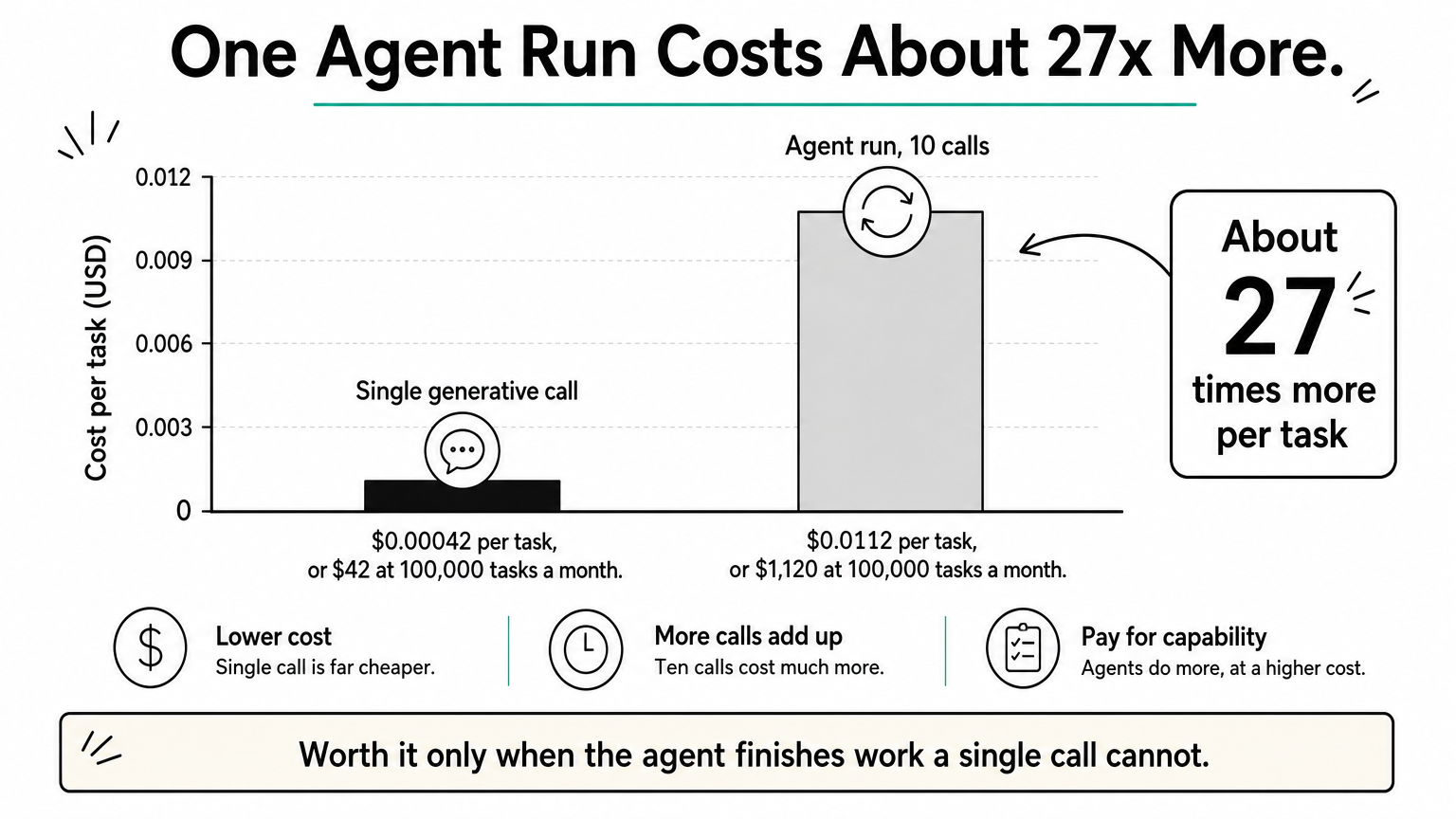
| Single generative call | Agent run (10 calls) | |
|---|---|---|
| Input tokens | 2,000 | 80,000 |
| Output tokens | 500 | 6,000 |
| Cost per task | $0.00042 | $0.0112 |
The agent run costs about 27 times more per task. At 100,000 tasks a month, that is $1,120 against $42. The extra spend is worth it only when the agent finishes work that a single call cannot.
Examples of agentic and generative AI in practice
You can sort most examples by asking whether the system only produces content or also acts on it. The gray zone is real, because the same model can sit behind both a chat box and an agent.
The label belongs to how a system is used, not to the name of the model.
Clear cases across common jobs
| Area | Generative AI | Agentic AI |
|---|---|---|
| Customer support | Drafts a reply for a person to send | Reads the ticket, checks the order system, issues the refund, and replies |
| Software | Writes a function from a prompt | Reads a repository, edits files, runs tests, and fixes failures |
| Security | Summarizes an alert | Investigates the alert, queries logs, and isolates a host within set policy |
| Marketing | Writes ad copy | Launches variants, tracks results, and shifts budget within a cap |
Is ChatGPT generative or agentic AI?
In a plain chat, ChatGPT is generative AI. It reads your prompt and writes a reply. When a product built on a model gets tools and permission to work across steps, such as browsing, running code, or filling in forms, it behaves agentically.
Coding assistants show the same split. Autocomplete is generative. A coding agent that opens files, runs your test suite, and iterates until it passes is agentic, often on the same underlying model. People also ask who the "big four" AI agents are, but there is no fixed list, and products change quickly. Judge a tool by whether it loops and acts, not by its brand.
What agentic AI asks of your model API
Agents ask more of a model API than one-shot generation does. They need steady latency across many calls, long context, reliable tool calling, and clear data handling. Every step is another inference, so one slow or flaky endpoint compounds into a failed run.
An agent is only as reliable as the slowest model call in its loop.
Requirements that matter for agent loops
- Consistent latency. Ten calls at 2 seconds each is 20 seconds, and a single timeout can break the run.
- Long context. Histories grow each step, so check the context limit and the maximum output.
- Tool calling and structured outputs. The agent needs to emit valid calls that your code can parse.
- Data handling. Agents send internal data into prompts, so look for zero data retention and clear regional hosting.
- Cost per token. Multiply the single-call price by your expected calls per task.
Three text models to compare
These Geodd models suit agent workloads. Prices are per 1M tokens.
| Model | Input / output price | Context | Maximum output |
|---|---|---|---|
| GLM 5.3 Flash | $0.110 / $0.400 | 1.05M | 128K |
| DeepSeek V4.1 Flash | $0.300 / $1.100 | 1.05M | 384K |
| GPT-OSS-120B | $0.039 / $0.158 | 131.07K | 131.07K |
All three run with zero data retention by default, and the API is OpenAI-compatible, so switching providers is a single-line change in the OpenAI SDK. GLM 5.3 Flash and DeepSeek V4.1 Flash are served from US-EAST. Capabilities and regions differ by endpoint, so check each model page before you commit.
Choosing between the two
Choosing between agentic AI and generative AI is a question of who finishes the job. If a person will use the output, a generative model is enough and costs far less. If the task has unknown steps, needs tools, and tolerates guardrails, an agent earns its higher token bill.
Most production agents are generative models inside a loop, so you rarely pick one and drop the other. Start with a single call, measure it, and add agency one step at a time.
If you're comparing hosted models for either approach, you can browse Geodd's model catalog and open each model page for pricing, capabilities, and integration examples.