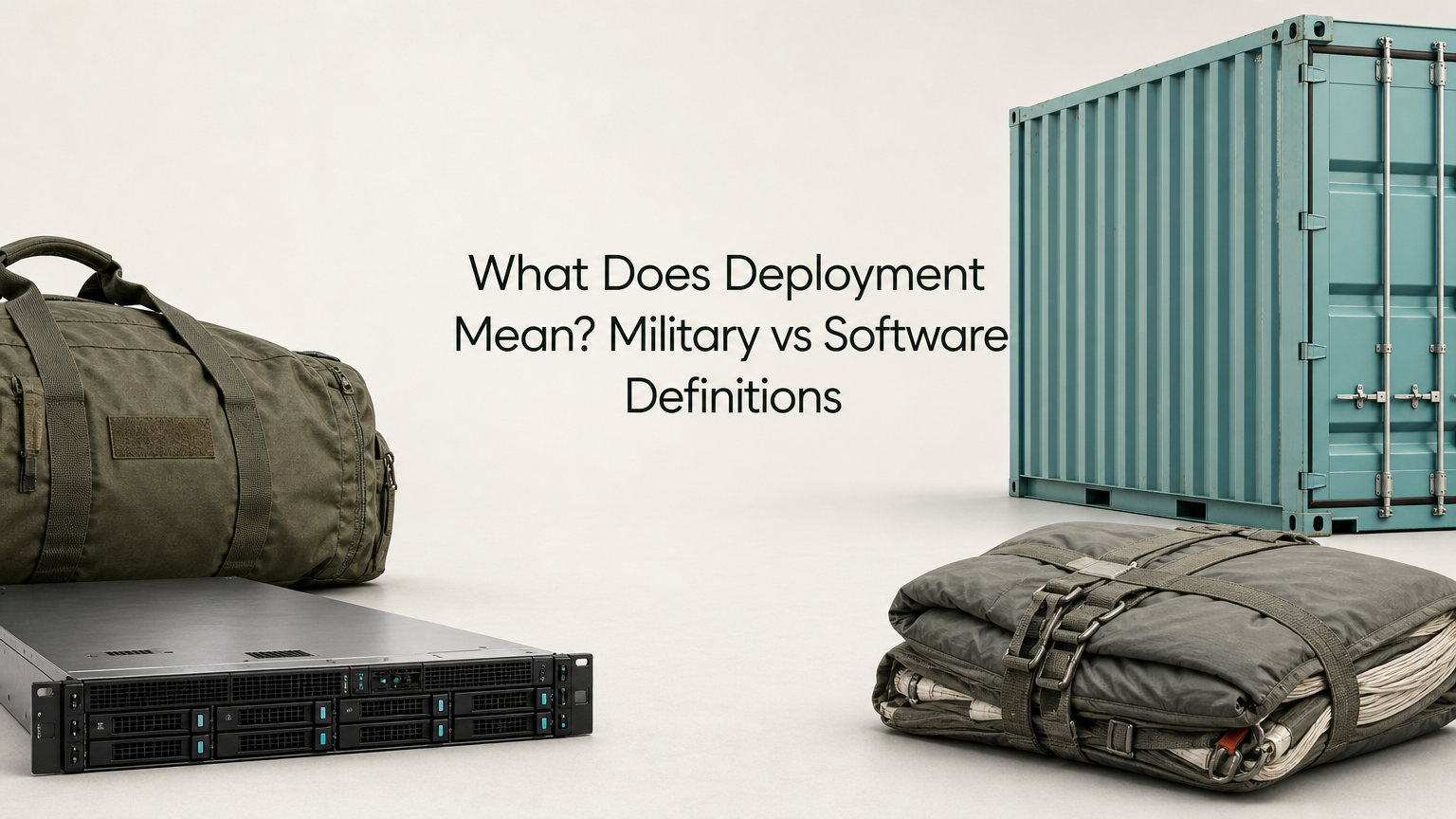
Deployment is the act of moving people, equipment, or software from a place where they are ready into a place where they do real work. In the military, it means sending forces and their support from a home station to an assignment elsewhere. In software, it means moving code from a development or staging environment into the live production environment where users reach it. If someone says a person is "in deployment," they almost always mean the military sense. If an engineer says it, they mean software.
This article separates the meanings so you can tell which one you are reading. It explains why context changes the definition, walks through how to deploy software step by step, and shows how a military deployment unfolds. It closes with the AI model sense of the word and the closest synonyms for each context.
Geodd runs AI inference infrastructure, so the software meaning is part of our daily vocabulary. Most people who search this word want the military meaning or a dictionary answer, so we cover both without assuming you work in tech.
Why the meaning of deployment depends on context
The word describes a transition, and every field has a different thing making that transition. That is why one sentence can mean two very different things to two readers.
The idea every definition shares
Dictionaries agree on the core. Merriam-Webster defines deployment as the act of deploying or the state of being deployed. Cambridge gives two senses: the effective use of something or someone, and the movement of soldiers or equipment. Both describe a shift from standby to action.
That shift is the part to remember. A soldier leaves a home station, a build leaves staging, a team member leaves the bench for a project. In each case the thing was ready but idle, and deployment is the moment it starts doing real work. The field only decides who is moving and what counts as "in use."
Deployment is the move from ready to in use, and the context tells you what is moving.
Deployment across contexts
The table shows how the same word maps to different fields.
| Context | What is deployed | Where it goes | Typical speaker |
|---|---|---|---|
| Military | Troops, equipment, logistics | From home station to an assignment | Service members, families |
| Software | Code, updates, configuration | From staging to production | Developers, DevOps teams |
| Business or staffing | People, budget, tools | To projects, sites, or teams | Managers, operations leads |
| Everyday objects | A parachute, an airbag | Out of storage into use | Anyone |
If a job posting lists deployment as a duty, read the words around it. In IT it means releasing software to users. In operations it means assigning people or equipment to sites. In a military role it means you may be sent away from your home station.
How to deploy software without breaking production
You deploy software by promoting a tested, versioned change from staging to production in a controlled way, with a plan to reverse it. Teams that skip the reversal plan are the ones that end up fixing things live.
A seven-step deployment process
Start with a versioned build in source control, usually Git, so you know exactly what is going live. Then confirm the prerequisites: operating system, dependencies, component versions, configuration, and secrets. Most failed deployments trace back to a mismatch here, not to the new code.
- Freeze a versioned build in source control.
- Check dependencies, configuration, and secrets against the target environment.
- Test in a staging environment that mirrors production.
- Pick a deployment strategy that fits your risk tolerance.
- Deploy through an automated CI/CD pipeline, not by hand.
- Watch error rates and latency, and record which release changed what.
- Roll back immediately if the numbers get worse.
Every deployment needs a rollback plan written before you ship, not after something breaks.
Choosing a deployment strategy
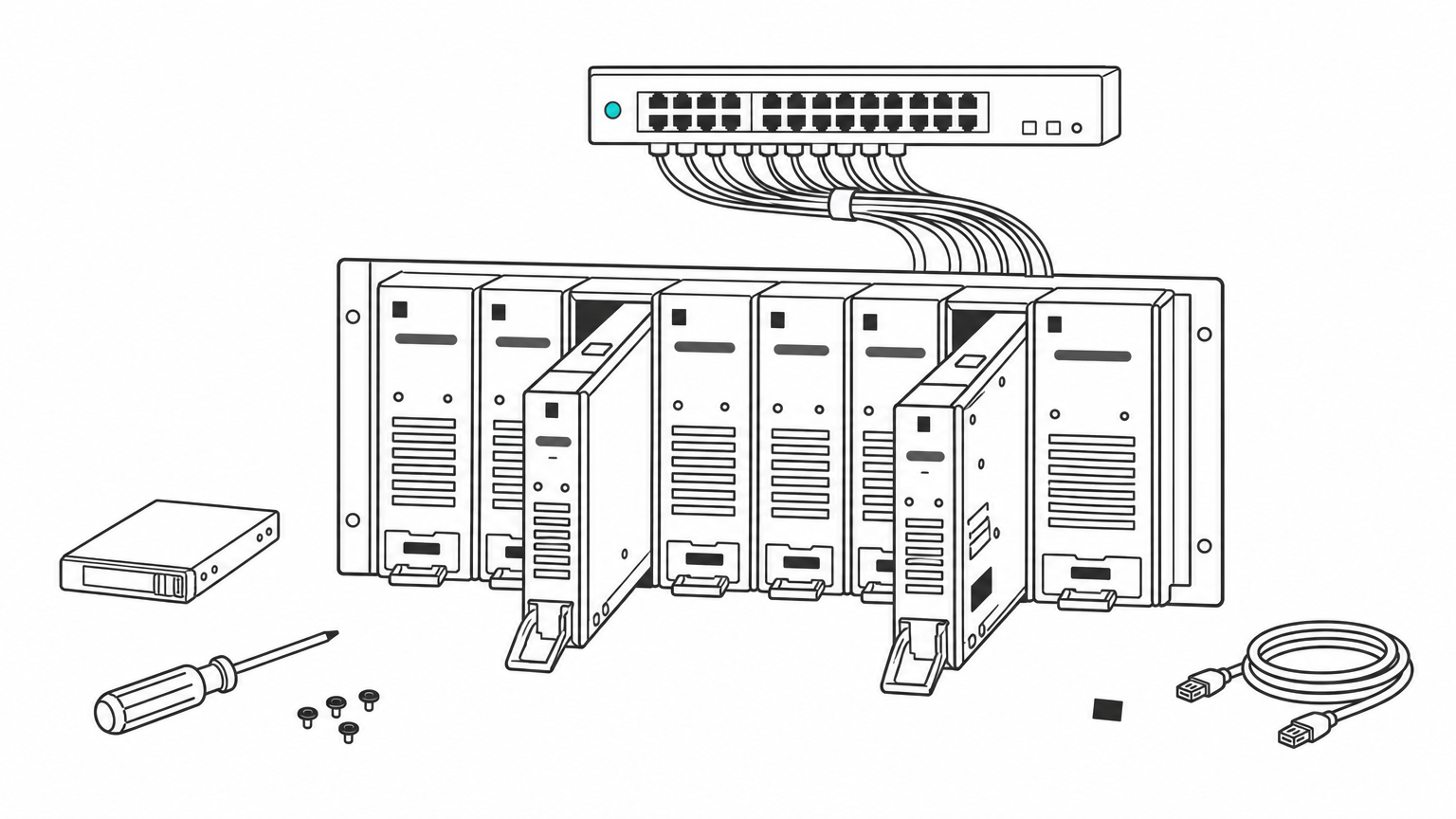
Each strategy trades speed, cost, and risk differently. Here are the common ones.
| Strategy | How it works | Main trade-off |
|---|---|---|
| Basic | Update every node at once | Simplest, but can cause downtime |
| Rolling | Update instances in batches | Less downtime, slower to finish |
| Blue/green | Run old and new versions side by side, then switch traffic | Fast rollback, needs double capacity |
| Canary | Send the new version to a small share of users first | Catches problems early, needs monitoring |
| Shadow | Mirror live traffic to the new version without serving its responses | Safe testing, extra cost |
| Feature flags | Ship code with the new behavior switched off, then enable it | Separates deploying from releasing |
Here is a worked example. You run 8 servers and update 2 at a time with a rolling deployment. That takes 4 batches, and at any moment 6 of 8 servers, or 75% of capacity, still serve users. If each batch takes 5 minutes, the full rollout takes 20 minutes with no outage.
How military deployment works
Military deployment is the movement of armed forces and their logistical support from a home station to an assignment elsewhere. It is a process with phases, not a single trip.
The phases of a deployment
The U.S. Army describes deployment as an integrated part of force projection, combined with mobilization, employment, sustainment, and redeployment. Its own handbook stresses that the actions overlap and are often nonsequential, so the phases below are a guide, not a strict timeline.
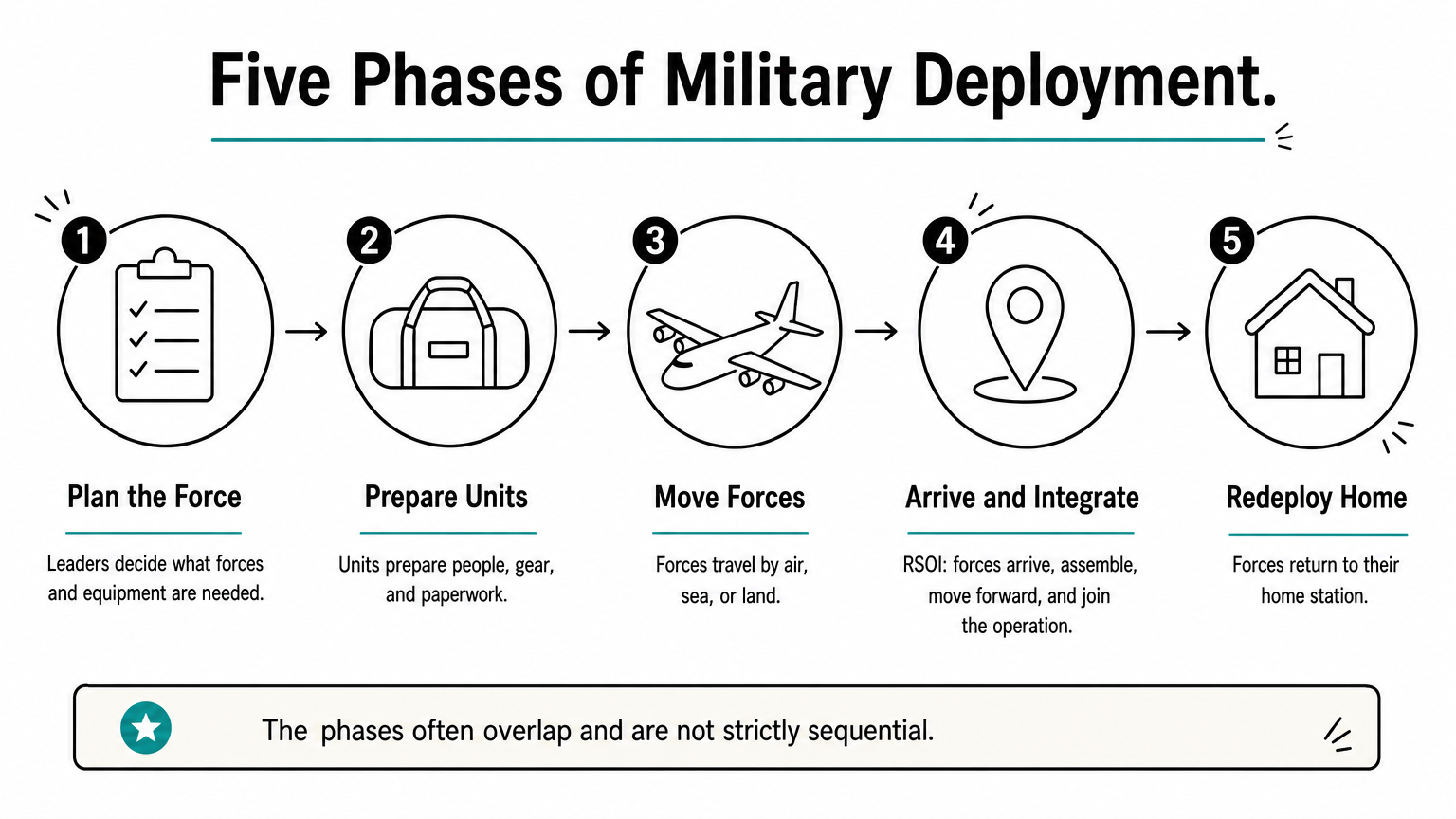
- Planning: leaders decide what forces and equipment are needed.
- Pre-deployment activities: units prepare people, gear, and paperwork.
- Movement: forces travel by air, sea, or land.
- Reception, staging, onward movement, and integration (RSOI): forces arrive, assemble, move forward, and join the operation.
- Redeployment: forces return to their home station.
A military deployment is a cycle that starts before departure and ends only after redeployment.
What deployment means for the person and family
For the individual, being deployed means being away from the home station on assignment. Active-duty soldiers and members of the Army Reserve and National Guard all receive full-time pay and benefits while deployed, according to the Army's own recruiting information.
Preparation reaches well beyond packing. Military OneSource points families to checklists covering finances, legal documents, and family care plans. If you are supporting someone who is deploying, start there rather than with general advice.
Deployment in AI, in a job, and in other words
In AI, deployment means putting a trained model behind an endpoint so applications can call it in production. It is the software meaning applied to a model, and the same staging, rollout, and rollback logic applies.
What deployment means for AI models
Teams usually choose between two routes. With serverless inference, you call a hosted model through an API and pay per token, and the provider handles the servers. With dedicated deployment, you reserve GPU capacity for your own workload. Self-hosting means you own every step of the software process above, plus the hardware.
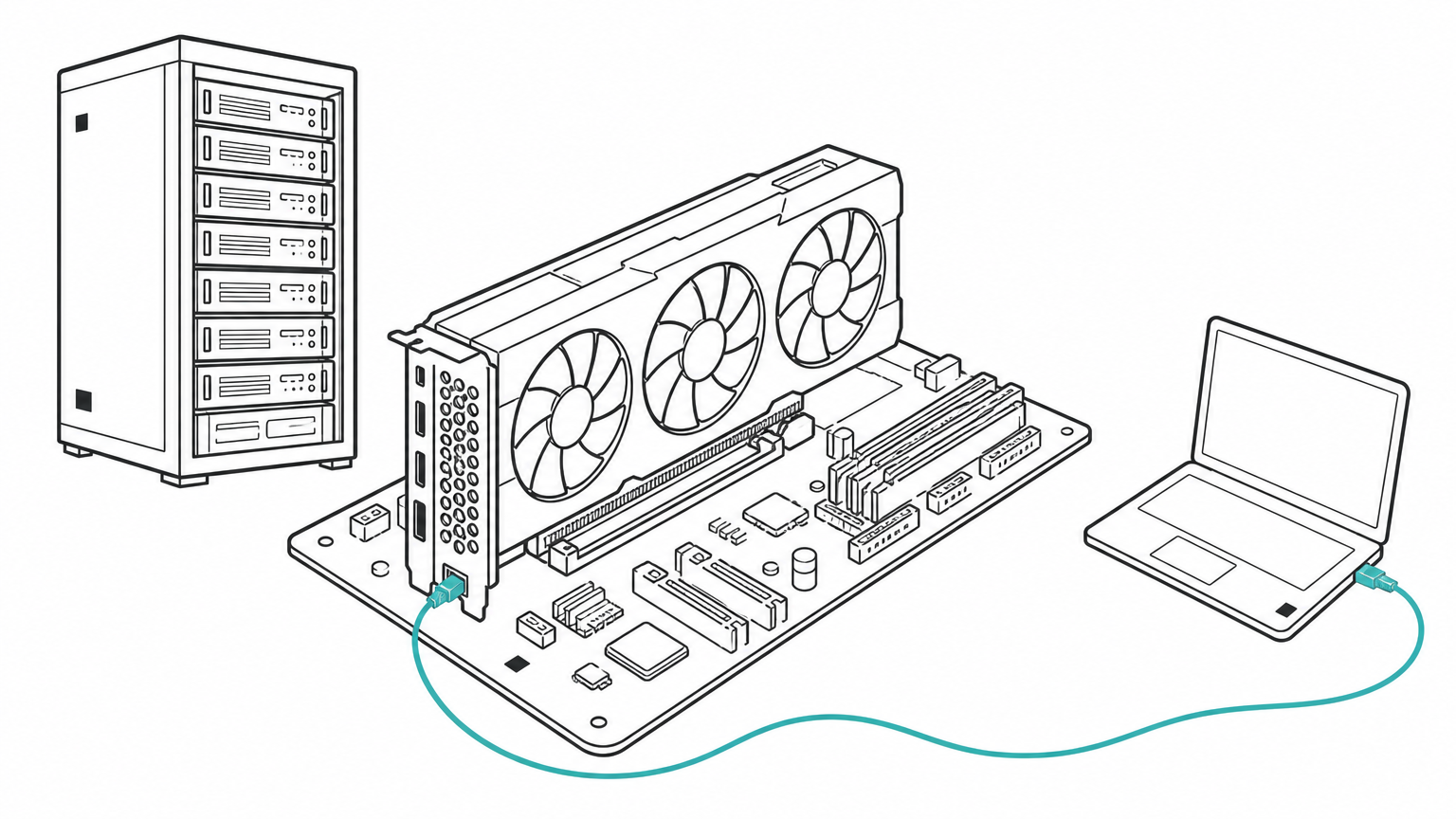
Geodd offers both routes through one SDK. It prices inference per token and prices dedicated setups on a flexible basis. The right choice depends on traffic shape, latency needs, and how much operations work your team wants to carry.
Synonyms and word choice
The best alternative depends on the sense you mean.
| Context | Closest alternatives | Watch out for |
|---|---|---|
| Software | Release, rollout, go-live, launch | A release can be a separate step from deploying the code |
| Military | Dispatch, posting, sending out | Mobilization is a related but distinct step |
| Business | Assignment, allocation, staffing | Implies people or resources, not code |
Pick the meaning that fits your context
Deployment means moving something from ready to in use. In the military that is forces and their support, in software it is code reaching production, and in AI it is a model serving real requests. The surrounding words almost always tell you which one applies.
If you are deciding how to run a model in production, compare serverless and dedicated inference options and match the approach to your traffic and latency needs.