The gpt-oss-120b vs GPT-5 choice is a trade between peak capability and cost. GPT-5 is the stronger model, accepts images, and offers a 400K context window, but it costs roughly 30 to 60 times more per token. gpt-oss-120b is OpenAI's open-weight model. It scores lower on benchmarks, yet it handles coding, tool calling and structured outputs well at a fraction of the price. Choose GPT-5 for hard reasoning, image input and very long documents. Choose gpt-oss-120b for high-volume agents, tight budgets, and data you need to keep under control.
Most comparisons stop at a benchmark chart. That doesn't tell you what a month of traffic will cost or whether the model fits your pipeline. This article covers six differences in the order they usually decide the pick: intelligence, price, context and inputs, speed, deployment control, and fit by use case. Each one ends with something you can act on.
At Geodd we serve gpt-oss-120b through an OpenAI-compatible API, so the cost examples use our posted token prices next to OpenAI's list prices for GPT-5. Performance figures come from OpenAI's published specs and one public production eval. We flag where they may not apply to your workload.
1. Intelligence and benchmark scores
How they compare
GPT-5 is the more capable model, and the gap is measurable but not huge. OpenAI reports that gpt-oss-120b reaches near-parity with o4-mini on core reasoning benchmarks, so you get last-generation frontier reasoning in an open model. On the Artificial Analysis Intelligence Index at launch, GPT-5 scored 68 and gpt-oss-120b scored 59.
| gpt-oss-120b | GPT-5 | |
|---|---|---|
| Intelligence Index at launch | 59 | 68 |
| Parameters | 117B total, 5.1B active per token | Not disclosed |
| Architecture | Mixture-of-experts, 128 experts, 4 active | Not public |
| Reasoning effort | Low, medium, high | Adjustable through the API |
| License | Apache 2.0 | Proprietary |
GPT-5 leads by about nine index points, but gpt-oss-120b still sits near the previous frontier.
What to do with it
Treat gaps on public LLM leaderboards as averages. In one public production eval, 2,000 credit card transactions went through yes/no fraud checks. GPT-5 reached 76.37% accuracy and gpt-oss-120b reached 70.24%, a six-point gap. GPT-4o scored 77.41%, ahead of both, which shows that "best GPT" depends on the task and the date, not the version number.
Build a small eval from 100 to 200 real examples and run both models before you commit. As a rule of thumb, if the accuracy gap on your task is under two points, the price difference in the next section usually settles the question.
2. Price per million tokens
How they compare
Price is the widest gap in the gpt-oss-120b vs GPT-5 comparison. GPT-5 lists at $1.25 per million input tokens and $10.00 per million output tokens. On Geodd, gpt-oss-120b costs $0.039 input and $0.158 output per million tokens. Public price lists for other hosts land in the same sub-$0.20 output range.
| Model | Input / 1M tokens | Output / 1M tokens |
|---|---|---|
| GPT-5 (OpenAI list price) | $1.25 | $10.00 |
| gpt-oss-120b on Geodd | $0.039 | $0.158 |
| Ratio | about 32x | about 63x |
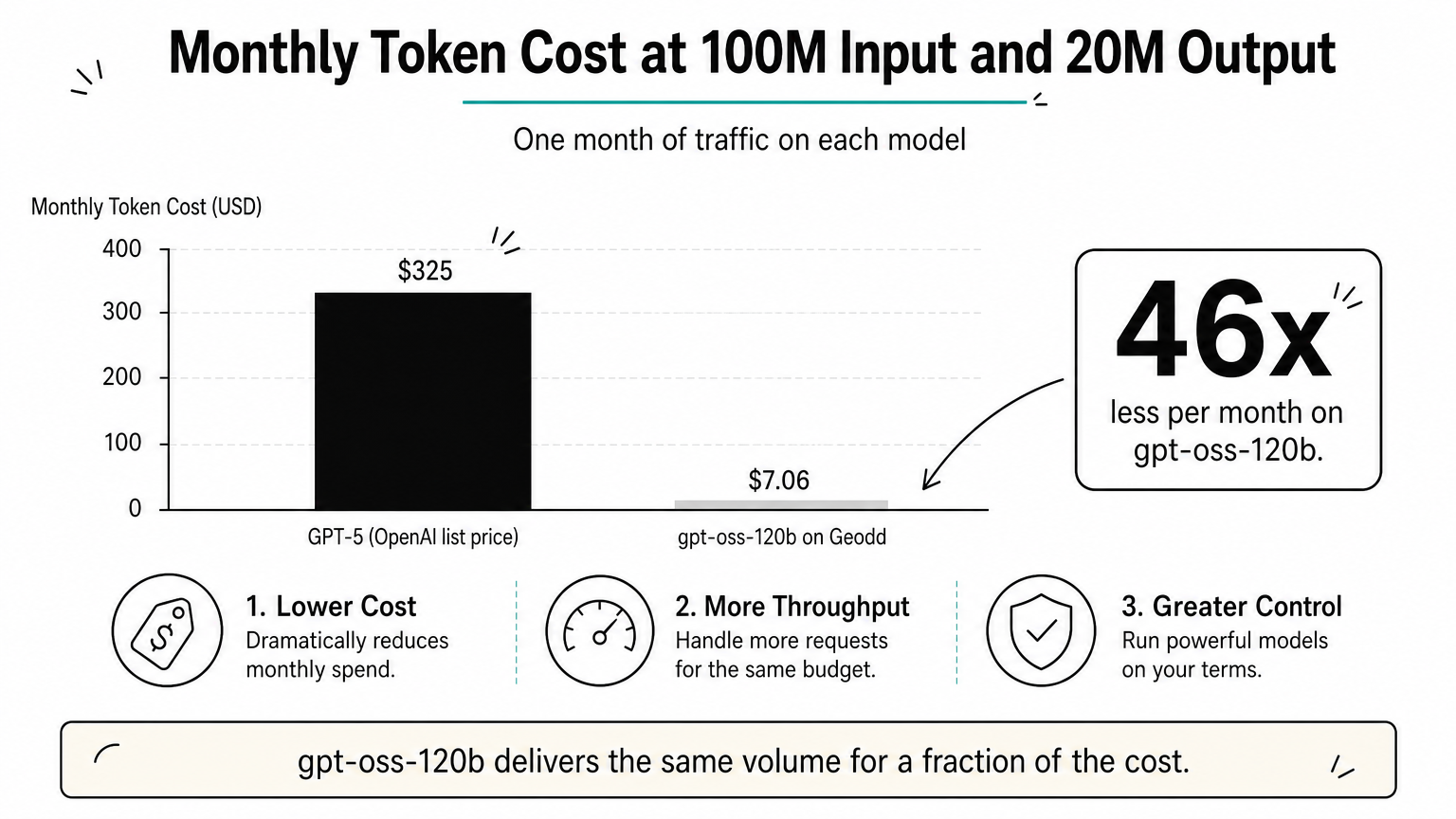
Here is a worked example. Say your app sends 100M input tokens and 20M output tokens a month. On GPT-5 that is 100 × $1.25 plus 20 × $10.00, or $325. On gpt-oss-120b through Geodd it is 100 × $0.039 plus 20 × $0.158, or about $7.06.
At 100M input and 20M output tokens a month, GPT-5 costs $325 and gpt-oss-120b costs about $7.
What to do with it
Reasoning tokens bill as output on both models, so budget your output volume higher than the visible answer length. OpenAI discounts cached input, which narrows the gap for repetitive prompts, but it does not close it.
Price decides the pick for classification, extraction, and agent loops that make dozens of calls per task. It matters less for low-volume, high-stakes work where one wrong answer costs more than a month of tokens. Estimate the cost of an error first, then compare it to the table.
3. Context window and input types
How they compare
GPT-5 handles about three times more context and accepts images. gpt-oss-120b supports up to 128K tokens natively, and Geodd lists its endpoint at 131.07K tokens of context and the same maximum output. GPT-5 offers 400K tokens.

| gpt-oss-120b | GPT-5 | |
|---|---|---|
| Context window | 128K native, 131.07K on Geodd | 400K |
| Input types | Text only | Text and images |
| Tool calling | Yes | Yes |
| Structured outputs | Yes | Yes |
If your prompt needs a screenshot or more than about 130K tokens, gpt-oss-120b is the wrong tool.
What to do with it
A 131K window holds roughly 90,000 to 100,000 words, enough for most codebases slices, contracts and support histories. Above that, use retrieval or chunking, or pick GPT-5.
For image input you have two options. Pick GPT-5, or pair gpt-oss-120b with a separate vision model that turns the image into text first. If your real need is more than 400K tokens, neither fits. GLM 5.3 Flash and DeepSeek V4.1 Flash both list 1.05M tokens of context on Geodd.
4. Speed and latency
How they compare
gpt-oss-120b is much faster per call in practice. In the same fraud eval, GPT-5 averaged 8.61 seconds per decision, while gpt-oss-120b averaged 1.72 seconds on its host. That is about five times faster.
| Model | Accuracy | Average time | Median time |
|---|---|---|---|
| GPT-5 | 76.37% | 8.61s | 8.08s |
| gpt-oss-120b | 70.24% | 1.72s | 1.37s |
| gpt-oss-20b | 73.42% | 1.68s | 1.36s |
These numbers describe short classification calls. Speed for gpt-oss-120b depends heavily on the host and its serving stack, and GPT-5 speed depends on the reasoning effort you set.
Per-call latency multiplies across every step of an agent loop.
What to do with it
An agent that makes 12 sequential calls turns 8 seconds per call into a minute and a half of waiting. At under 2 seconds per call, the same chain finishes in about 20 seconds. For chat, copilots and multi-step agents, that gap is the difference between usable and abandoned.
If you want OpenAI's hosted API at lower cost, compare GPT-5 mini as well. It scored 71.04% in the same eval, close to gpt-oss-120b, though its token prices are still several times higher.
5. Deployment, control, and data handling
How they compare
gpt-oss-120b gives you control, and GPT-5 gives you convenience. The gpt-oss-120b weights are free to download under Apache 2.0. The model ships quantized in MXFP4 and runs on a single 80 GB GPU, so you can self-host, fine-tune, or call it from a hosted provider. GPT-5 weights are closed. You call it through a hosted API and you cannot inspect, modify or run it on your own hardware.
Hosted gpt-oss-120b keeps the migration cost low. Geodd serves it as openai/gpt-oss-120b through an OpenAI-compatible API, with zero data retention by default. Geodd does not use API data for model training. EU customers get API inference on EU data center infrastructure by default.
from openai import OpenAI

client = OpenAI(base_url="PROVIDER_BASE_URL", api_key="PROVIDER_API_KEY")
resp = client.chat.completions.create(
    model="openai/gpt-oss-120b",
    messages=[{"role": "user", "content": "Summarize this ticket."}],
)
With an OpenAI-compatible endpoint, switching between these models is a base URL and a model name.
What to do with it
Pick gpt-oss-120b when you need fine-tuning, offline or on-premises operation, or strict control over where prompts are processed. Pick GPT-5 when you want zero infrastructure work and OpenAI's managed features.
A hosted open-weight endpoint is the middle path. You skip the cost of buying and running GPUs, and you keep portability because the weights are public. Check the provider's model page for regional endpoints and retention terms before you send sensitive data.
6. Fit by use case
How they compare
Each model has clear territory, and the table below maps common workloads to a default pick. Treat it as a starting point and verify on your own data.
| Use case | Default pick | Reason |
|---|---|---|
| High-volume classification and extraction | gpt-oss-120b | Price and latency |
| Coding agents with tool calls | gpt-oss-120b, escalate to GPT-5 | Cheap loops, strong fallback |
| Hard math, science, open-ended reasoning | GPT-5 | Higher intelligence score |
| Screenshots or image input | GPT-5 | gpt-oss is text only |
| Documents beyond 131K tokens | GPT-5 or retrieval | 400K window |
| Fine-tuning, on-prem, strict data control | gpt-oss-120b | Open weights |
| Tighter latency on simple tasks | gpt-oss-20b | Smaller, fits 16 GB |
What to do with it
You don't have to choose one. A routing pattern works well: send every request to gpt-oss-120b first, validate the output, and escalate only failures or flagged hard cases to GPT-5. Most traffic then costs gpt-oss prices, while the hard tail gets GPT-5 quality.
Default to gpt-oss-120b and pay for GPT-5 only when a request proves it needs it.
Also test the smaller gpt-oss-20b model. In the eval above it scored 73.42%, higher than the 120B model's 70.24%, so the larger model is not always the better pick for narrow, well-defined tasks.
Which model should you pick?
Use GPT-5 when the task is hard, needs images, or needs a context window beyond 131K tokens, and the volume is low enough that $10 per million output tokens is acceptable. Use gpt-oss-120b when volume, latency or data control drive the decision. It costs about 46 times less in the worked example, answers several times faster, and you can host it, tune it, or move it between providers.
Run a small eval on your own prompts, price your real token volume, and consider routing so each model does the work it is good at. If gpt-oss-120b fits, you can try gpt-oss-120b through Geodd's OpenAI-compatible API and review token pricing, capabilities and data handling on the model page.