Kimi API pricing is the pay-as-you-go rate Moonshot AI charges for each token your application sends to and receives from a Kimi model. Input and output tokens are billed separately, per million tokens, and cached input is billed at a discount. As of October 2026, the flagship kimi-k3.1-pro costs $2.00 per million input tokens and $10.00 per million output tokens. The older kimi-k2.6 costs $0.95 and $4.00. There is no subscription plan on the API platform.
The headline rates only tell you part of the story. Your real bill depends on how long your prompts are, how much of each prompt repeats, and which model generation you pick. This article lays out the current rates side by side. It also covers where Kimi K2.5 pricing stands, works through a cost estimate with real numbers, and explains how the API differs from a Kimi membership.
Geodd serves Kimi K2.6 through an OpenAI-compatible API, so we read these price sheets the way a buyer does. We refer to that model where it helps you compare options.
Why Kimi API pricing matters before you build
Your Kimi API cost is metered, not flat, so it moves with three things you control: the model, the length of your prompts, and how often you reuse context. A wrong guess on any of them can double a monthly bill.
What you actually pay for
Every request is billed on input tokens and output tokens, each at its own rate. A token is a short sequence of characters, and for typical English text one token is roughly 3 to 4 characters. Output is the expensive side. On kimi-k3.1-pro it costs five times the input rate, and on kimi-k2.6 about 4.2 times. A chatty model with long answers costs far more than the prompt length suggests.
Long documents count too. If you extract text from a file and pass it to the model as input, that text is billed as input tokens. The file extraction and storage APIs themselves are currently free.
Prices change with model generations
The price you find in an old blog post may no longer be on the sheet. The K2 series closes to newly registered users on October 31, 2026, and Moonshot plans to retire all K2 models by the end of December 2026. Existing users are not affected until then.
K2.5 no longer appears in the official table at all. If you are starting a project now, budget against the K3 series or plan a migration.
Token billing makes your model choice and prompt design the two biggest levers on your Kimi bill.
Current Kimi API prices per million tokens
The table below lists the official Kimi API price per million tokens (MTok) for each current model, in US dollars and before taxes.
Official rates for K3 and K2 models
| Model | Input | Output | Cache hit | Context window |
|---|---|---|---|---|
| kimi-k3.1-pro | $2.00 | $10.00 | $0.20 | 1,048,576 |
| kimi-k3.1-pro-highspeed | $4.00 | $20.00 | $0.20 | 1,048,576 |
| kimi-k3 | $3.00 | $15.00 | $0.30 | 1,048,576 |
| kimi-k2.7-code | $0.95 | $4.00 | $0.19 | 262,144 |
| kimi-k2.7-code-highspeed | $1.90 | $8.00 | $0.38 | 262,144 |
| kimi-k2.6 | $0.95 | $4.00 | $0.16 | 262,144 |
K3 pricing is flat across the whole context window, with no higher tier for long prompts. K3 models also list cache-write prices by time-to-live. For kimi-k3.1-pro, a 5-minute write is $2.00 and a 1-hour write is $4.00 per MTok. The default TTL is 5 minutes, and caching is enabled automatically for repeated request prefixes.
The highspeed variants cost exactly double the standard rates. Pay that premium only if latency matters more than cost.
Kimi K2.5 API pricing
The official table no longer lists Kimi K2.5, so there is no current first-party K2.5 rate to quote. A third-party model router publishes $0.45 per million input tokens and $2.25 per million output tokens, with cache reads at $0.07. Treat those numbers as that provider's rates, not Moonshot's.
For a model on the official sheet in the same class, look at kimi-k2.6. Geodd serves it as moonshotai/Kimi-K2.6 from US-EAST with a 262.14K-token context and zero data retention by default. Check the model page for its current token rates.
If a model is missing from the official table, any price you find for it belongs to whoever hosts it.
How to estimate your Kimi API cost
Estimate cost by multiplying your daily input tokens and output tokens by their per-million rates, then subtracting the savings from cached input. Run the numbers before you commit to a model.
A worked example
Take an app that sends 1,000 requests a day. Each request has 3,000 input tokens, of which 2,000 are a repeated system prompt, and returns 500 output tokens. That is 3M input and 0.5M output tokens per day. With caching, 2M of the input tokens are billed at the cache-hit rate and 1M at the full rate. This ignores the occasional cache write.
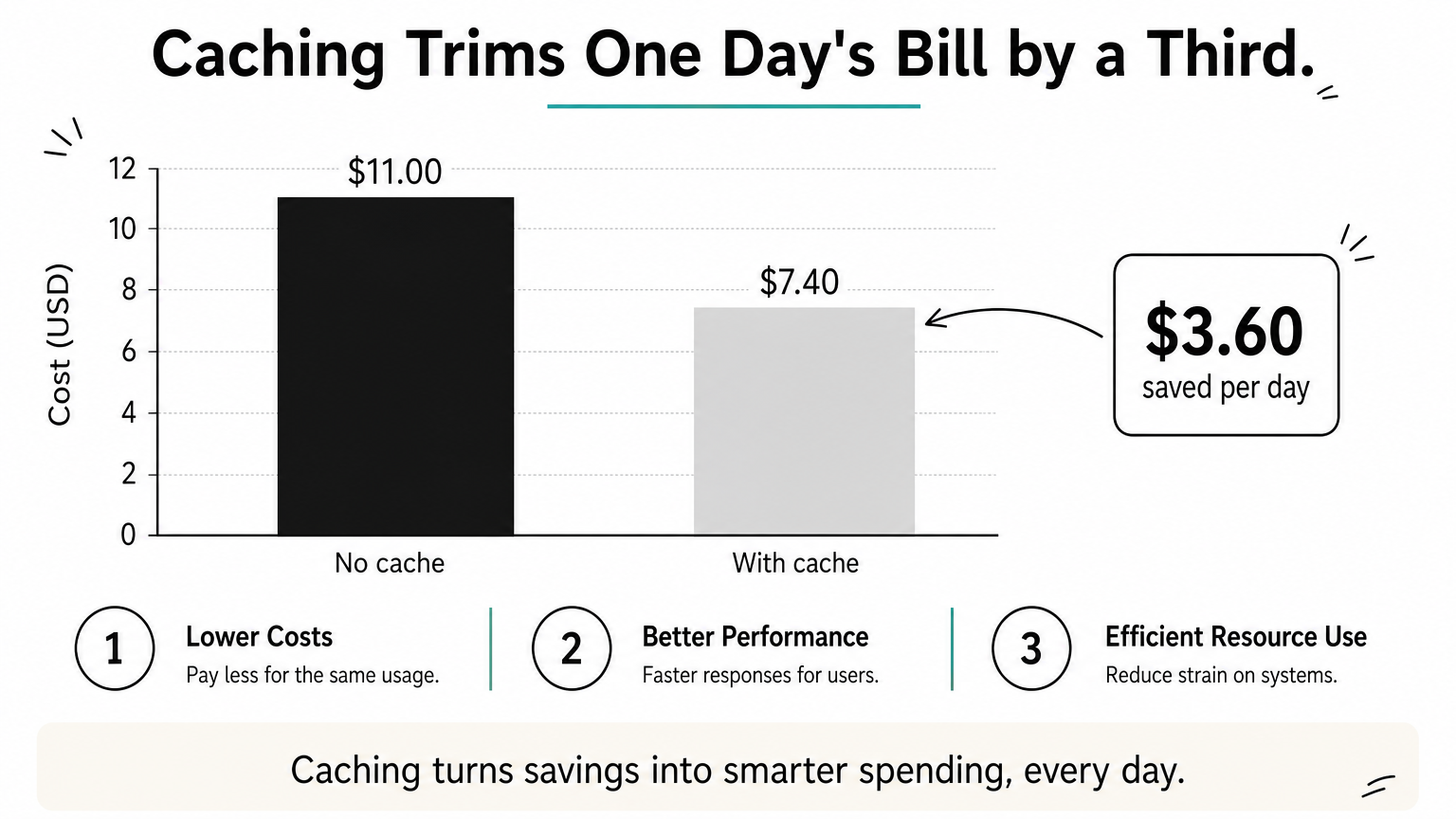
| Model | Per day, no cache | Per day, with cache | 30 days, with cache |
|---|---|---|---|
| kimi-k3.1-pro | $11.00 | $7.40 | $222.00 |
| kimi-k2.6 | $4.85 | $3.27 | $98.10 |
For kimi-k3.1-pro the uncached day is 3 × $2.00 plus 0.5 × $10.00, which is $11.00. The cached day is 2 × $0.20, plus 1 × $2.00, plus $5.00, which is $7.40. Caching saves about a third in both rows.
Ways to cut the bill
These steps come straight from how the billing works:
- Set
max_tokensso the model cannot ramble, because output is the pricier side. - Put stable content first in every prompt, since caching applies to repeated prefixes.
- Use a lighter model such as kimi-k2.6 for simple tasks and keep K3 for hard ones.
- Trim prompts of boilerplate and unused context.
- Watch tool use. Each web search call adds $0.004, on top of token charges.
Put repeated context at the start of your prompt, because a cached prefix is billed at roughly a tenth of the input rate.
Pay-as-you-go API versus Kimi subscription plans
The Kimi API is billed only by usage, while a Kimi membership is a separate product with fixed plan tiers. Pick the API when software calls the model, and a membership when a person uses Kimi in the app.
How the two differ
| Kimi API | Kimi membership | |
|---|---|---|
| Billing | Per token, pay as you go | Fixed plan tiers |
| Built for | Applications and automation | Individual use of the Kimi app |
| Cost control | Model choice, prompt size, caching | Choosing a plan |
Moonshot also sells Kimi Code separately, and the API platform treats all of these as different products. Don't assume a subscription's credits convert into API dollars. The membership page lists its own tiers, so compare it there rather than against token rates.
Is the Kimi API free?
No free tier appears on the pricing page. Only the file extraction and storage APIs are marked as temporarily free, and model calls are billed from the first token. The listed prices also exclude taxes, which are calculated at checkout based on your location, so add them to your budget.
The API has no monthly fee, but every token costs money, so set a usage estimate before you ship.
Picking a Kimi model and budget
Kimi API pricing comes down to a per-token rate for input, output, and cached input, applied to the model you choose. K3.1 Pro leads the current lineup at $2.00 input and $10.00 output per million tokens, and kimi-k2.6 undercuts it at $0.95 and $4.00 while it is still available. Caching and a sensible max_tokens cut a typical bill by about a third.
If you want Kimi K2.6 behind an OpenAI-compatible endpoint, you can try Kimi K2.6 through Geodd's API and review its token pricing, context limits and integration examples before you commit.