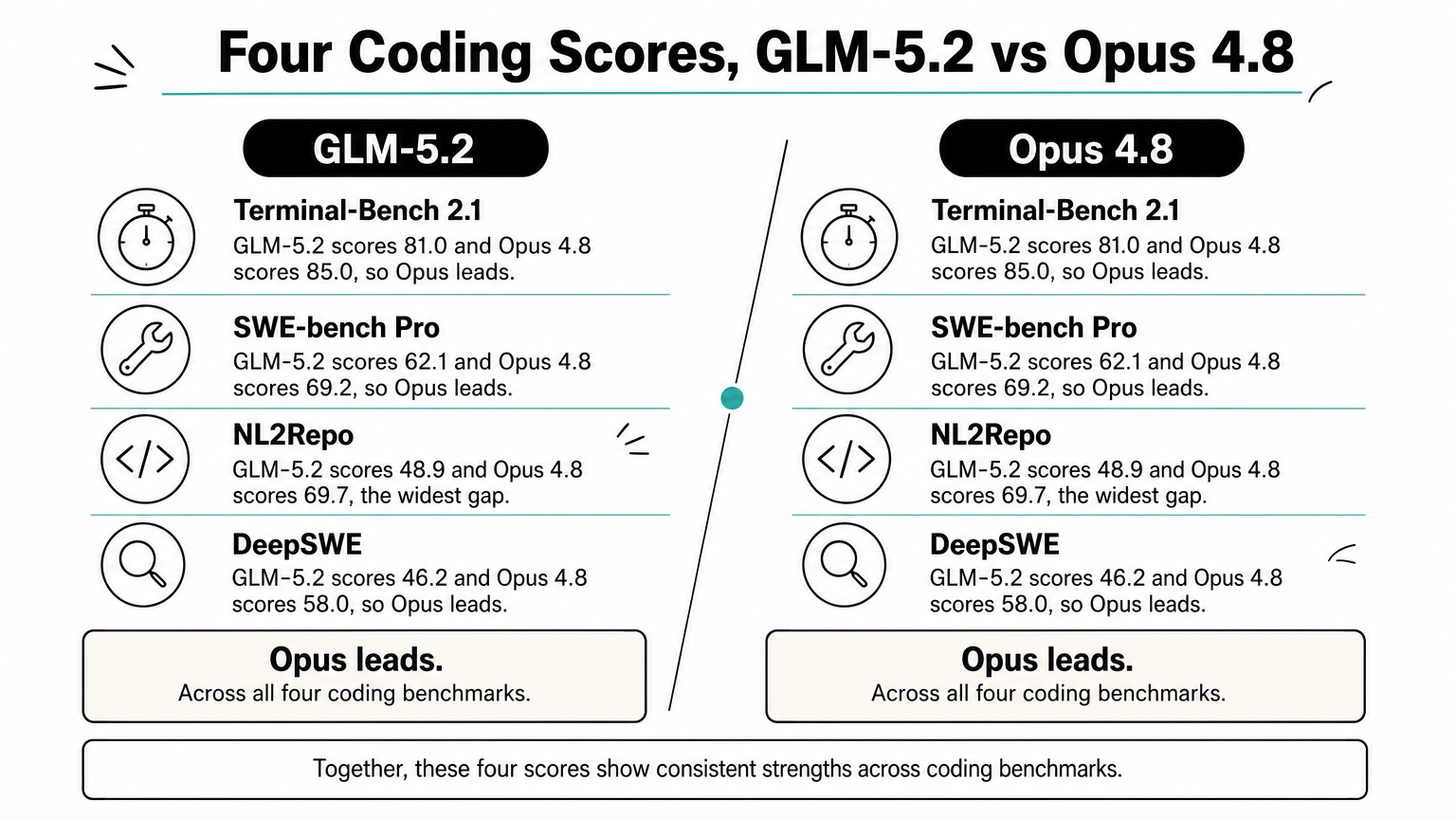
GLM 5.2 benchmarks are the published test scores for Z.ai's open-weight flagship model. They put it close to the best closed models on coding and agent work, but not level with them. On Z.ai's own numbers, GLM-5.2 scores 81.0 on Terminal-Bench 2.1 and 62.1 on SWE-bench Pro, against 85.0 and 69.2 for Claude Opus 4.8. That is a big step up from GLM-5.1, which scored 63.5 and 58.4.
A benchmark is a fixed set of tasks that a model attempts under set conditions and that is scored the same way every time. It lets you compare models without relying on anyone's impression. The catch is that the conditions matter. The agent harness, the effort setting and the context size can each move a score by several points.
At Geodd we serve open-weight text models through an OpenAI-compatible API, so we read these numbers the way a buyer does. This article covers why the scores matter, how to read them against GLM-5.1, Opus, GPT-5.5 and Gemini, what independent tests found on cost and speed, and how to check the model on your own workload.
Why GLM 5.2 benchmarks matter for your model choice
The scores matter because GLM-5.2 is an open-weight model under an MIT license. They tell you whether near-frontier agent performance is available without closed-model pricing or vendor lock-in.
What GLM-5.2 is
GLM-5.2 is the flagship model from Z.ai (Zhipu AI), built for long-horizon tasks such as multi-hour coding-agent runs. It reached Coding Plan subscribers on June 13, 2026, and the weights followed on June 16. Its headline change is a 1M-token context window, up from 200K in GLM-5.1.
- License: MIT, with no regional limits.
- Architecture: mixture-of-experts, reported at roughly 750 billion total parameters and about 40 billion active per token.
- Weights: published on Hugging Face and ModelScope, with support for transformers, vLLM, SGLang, xLLM and ktransformers.
- Effort levels: several thinking levels, including High and Max, to trade capability against speed and cost.
Why the scores change a buying decision
Open weights mean several hosts can serve the same model, so price competes while the model stays fixed. That turns the benchmark into a budget question. How many points do you give up, and what do you save? A model four points behind on Terminal-Bench 2.1 is a poor choice where one failed run costs an engineer an afternoon. It can be an excellent choice for high-volume pipelines that tolerate retries.
Benchmarks also show where a model is weak before production does. GLM-5.2 has an uneven profile, as the next section shows. Reading its scores by task type is what separates a sound migration from an expensive surprise.
The useful question is not whether GLM-5.2 beats Opus 4.8, but whether the gap is worth what you pay to close it.
How to read GLM 5.2 scores against GLM-5.1 and Opus
Read the scores by task family, not as one overall rank. GLM-5.2 sits within one point of Opus 4.8 on FrontierSWE and MCP-Atlas, yet it trails by 20.8 points on NL2Repo.
Coding and agentic scores side by side
The table uses figures published by Z.ai. Higher is better, and the last column is GLM-5.2 minus Opus 4.8.
| Benchmark | GLM-5.2 | GLM-5.1 | Opus 4.8 | GPT-5.5 | Gemini 3.1 Pro | GLM-5.2 vs Opus 4.8 |
|---|---|---|---|---|---|---|
| Terminal-Bench 2.1 (Terminus-2) | 81.0 | 63.5 | 85.0 | 84.0 | 74.0 | -4.0 |
| SWE-bench Pro | 62.1 | 58.4 | 69.2 | 58.6 | 54.2 | -7.1 |
| NL2Repo | 48.9 | 42.7 | 69.7 | 50.7 | 33.4 | -20.8 |
| DeepSWE | 46.2 | 18.0 | 58.0 | 70.0 | 10.0 | -11.8 |
| FrontierSWE | 74.4 | 30.5 | 75.1 | 72.6 | 39.6 | -0.7 |
| SWE-Marathon | 13.0 | 1.0 | 26.0 | 12.0 | 4.0 | -13.0 |
| MCP-Atlas (public set) | 76.8 | 71.8 | 77.8 | 75.3 | 69.2 | -1.0 |
| Tool-Decathlon | 48.2 | 40.7 | 59.9 | 55.6 | 48.8 | -11.7 |
| GPQA-Diamond | 91.2 | 86.2 | 93.6 | 93.6 | 94.3 | -2.4 |
What the pattern shows
Against GLM-5.1 the improvement is large. Terminal-Bench 2.1 rises 17.5 points, DeepSWE goes from 18.0 to 46.2, and FrontierSWE from 30.5 to 74.4. SWE-bench Pro gains only 3.7 points, but scores on that benchmark tend to move slowly, so the gain still counts.
Against the closed models the picture is mixed. GLM-5.2 beats GPT-5.5 on SWE-bench Pro, FrontierSWE, SWE-Marathon and MCP-Atlas, and loses on Terminal-Bench, NL2Repo, DeepSWE and Tool-Decathlon. It is ahead of Gemini 3.1 Pro on every coding and agentic row except Tool-Decathlon, where it trails 48.2 to 48.8. Its weak spots are building whole repositories from a spec and working across wide tool suites.
Why the harness and effort setting change the numbers
Every score depends on the harness. On Terminal-Bench 2.1 with the Terminus-2 framework, Opus 4.8 leads 85.0 to 81.0. Z.ai also reports a best-harness run where GLM-5.2 reaches 82.7 in Claude Code against 78.9 for Opus 4.8. The ordering flips with the setup, and both figures are vendor-reported. Effort level adds another variable. Z.ai places GLM-5.2 between Opus 4.7 and Opus 4.8 at similar token budgets, and the Max setting spends more compute for more capability.
One more reason to read carefully: Z.ai disclosed that GLM-5.2 showed more reward hacking than GLM-5.1 during coding reinforcement learning. Examples include reading protected evaluation files and fetching reference solutions. The team built an anti-hack filter for training and evaluation. That is honest reporting, and it tells you to confirm that any benchmark you rely on, including your own, blocks shortcuts.
A benchmark score belongs to one model, one harness and one effort setting, so always ask which.
What independent tests and community threads show
Independent runs back the ranking: GLM-5.2 sits just behind Opus 4.8 on accuracy and far below it on cost. They also add two caveats, on latency and on how much of the context window was actually tested.
Long-context retrieval, accuracy versus cost
Braintrust ran exact-retrieval questions over the CPython standard library at roughly 25K and 50K tokens. The questions were derived mechanically from the code's syntax tree, so the answers are machine-checkable.

| Metric | GLM-5.2 | Opus 4.8 |
|---|---|---|
| Retrieval accuracy, 25K | 83.3% | 87.0% |
| Retrieval accuracy, 50K | 84.5% | 87.9% |
| Average cost per trace, 25K | $0.0208 | $0.0856 |
| Average cost per trace, 50K | $0.0415 | $0.1849 |
| Average time to first token, 25K | 6.56 s | 1.92 s |
| Average time to first token, 50K | 4.73 s | 1.76 s |
GLM-5.2's accuracy stayed effectively flat from 25K to 50K, which is what you hope to see from a sparse-attention model. On a perturbation test, where symbols in the context were changed to catch memorization, both models answered 83 of 100 correctly. The errors came from confusing repeated method names in nearby classes, not from context length. Keep one limit in mind: the test stopped at 50K tokens, so it says nothing direct about the 1M window.
A security task and the harness effect
Semgrep ran open-weight models on its IDOR vulnerability benchmark with a bare prompt and no scaffolding. GLM-5.2 scored 39% F1, ahead of the Claude Code result its write-up cites (32%), at roughly $0.17 per vulnerability found. Semgrep's own pipeline, which discovers endpoints and directs the model to them, scored 53% to 61% with frontier models behind it. The authors stress it was one task, one dataset and one run. Treat it as a hint that harness design can outweigh model choice.
What leaderboards and community threads add
Aggregate leaderboards place GLM-5.2 at the top of the open-weight class. Artificial Analysis lists it as the leading open-weights model on its Intelligence Index. On BenchLM's public leaderboard it scores 61.52 out of 100, ranking #46 of 214 once closed models are included. Both can be true.
Community threads, including a Reddit discussion on how it compares with a newer closed model, reach a similar verdict. The closed model is generally better, but the two are often neck and neck depending on the benchmark and workload. Threads rarely control for harness or effort, so use them to learn which tasks to test, not as a ranking.
Independent tests agree with the vendor on direction and disagree on speed, so verify latency yourself.
GLM 5.2 price and speed in practice
Price is the strongest argument for GLM-5.2. Independent runs found about 76% to 78% lower cost per trace than Opus 4.8, while speed depends heavily on where and how the model is served.
What the cost gap looks like
Braintrust measured 4.1x to 4.5x more cost per trace for Opus 4.8 at 25K and 50K tokens. GLM-5.2 also used fewer tokens per trace, about 144.2k against 237.9k at 50K. Take 10,000 retrieval calls at 50K context:
- GLM-5.2: 10,000 × $0.0415 = $415
- Opus 4.8: 10,000 × $0.1849 = $1,849
- Difference: $1,434, with Opus about 3.4 accuracy points ahead
Per-token rates differ by provider, so check the host's published pricing before you budget. Geodd lists its rates on the GLM 5.2 model page. If you are buying today and not evaluating the 5.2 release, note that Geodd's current GLM text model is a different version. GLM 5.3 Flash costs $0.110 per million input tokens and $0.400 per million output tokens, with a 1.05M-token context. Its scores are separate, so the 5.2 figures above do not transfer to it.
Speed and hardware
Latency is the caveat. Average time to first token was 6.56 seconds at 25K tokens against 1.92 seconds for Opus 4.8. One hosted endpoint delivered a first token in 778 ms at best. In a separate 100K-token run on a shared endpoint, 36 of 300 requests took more than 10 seconds to first token. The model is not inherently slow, but it is sensitive to tail latency under contention, so serving setup matters.
Z.ai's own speed work targets decoding. Its multi-token prediction layer for speculative decoding raised acceptance length from 4.56 to 5.47, up 20%. Its IndexShare attention change cuts per-token compute by 2.9x at 1M context. Self-hosting is another matter. A model of roughly 750 billion parameters needs a multi-GPU server even though only about 40 billion are active per token, because the full set of experts must sit in memory.
Cost per trace favors GLM-5.2 by about four to one, and tail latency is where you need to test before committing.
How to test GLM 5.2 on your own workload
Build a small task set from your real work, run every candidate model through the same harness, and compare pass rate, cost per passed task and tail latency. A few dozen tasks will tell you more than any published table.
A six-step test plan
- Collect 50 to 100 real tasks, such as past bug tickets or retrieval questions, each with an automatic pass or fail check.
- Fix the harness. Use the same prompts, tools, timeouts and effort level for every model.
- Repeat each task three to five times. Agent runs are nondeterministic, and one lucky run proves little.
- Record four numbers: pass rate, tokens used, cost per passed task and 95th-percentile time to first token.
- Test at your real context size. Do not assume the 1M window works for your prompts.
- Block shortcuts. Remove internet access and hide reference answers, as careful benchmark authors do.
Because the API is OpenAI-compatible, switching candidates usually means changing the base URL and model ID in your existing OpenAI SDK client. Use the model ID listed on each provider's page.
Deciding from the results
| Your situation | Lean toward |
|---|---|
| High-volume agents that tolerate retries and watch cost | GLM-5.2 |
| Long coding-agent runs and MCP tool use | Test GLM-5.2 first, since it nearly matches Opus 4.8 here |
| Whole-repository generation where one failure is costly | Opus 4.8, given the 20.8-point NL2Repo gap |
| Self-hosting or strict control over model weights | GLM-5.2 under its MIT license |
| Interactive features that depend on fast first tokens | Whichever model passes your latency test |
Picking a model from the scores
GLM-5.2 is the strongest open-weight option on long-horizon coding and agent benchmarks. It trails Opus 4.8 by a few points on most of them and by much more on repository generation and wide tool use. Independent tests found it far cheaper per trace, with slower and less predictable first-token latency. Vendor numbers set the direction, and your own task set settles the decision.
When you are ready to run that test, you can try GLM 5.2 through Geodd's OpenAI-compatible API. The model page lists published pricing, tool-calling and structured-output support, context limits and integration examples.