The GLM 5.3 API is the hosted interface to Z.ai's GLM-5.3 model, a text-in, text-out model built for software engineering and long-horizon agent tasks. You send requests over HTTPS with an API key and pay per token. Z.ai lists it at $1.40 per million input tokens and $4.40 per million output tokens, and several inference providers host it too.
This article covers why the model is worth evaluating, how to get a key and make a first call, what it costs next to its cheaper Flash sibling, and how to choose a provider. The goal is that you can make a purchase or integration decision without opening ten tabs.
Geodd serves GLM 5.3 Flash through an OpenAI-compatible API, so you will see Flash figures next to the full model. They are different endpoints with different prices, and this article keeps them apart.
Why the GLM 5.3 API matters for coding and agents
GLM 5.3 matters because it pairs strong coding performance with open weights and a standard pay-per-token endpoint. Z.ai calls it its flagship for complex software engineering and agent work. It also reports a 50% improvement over GLM-5.2 on its in-house Z.ai Code Bench.
What the model is built for
That benchmark is vendor-run, so treat it as a reason to test, not as proof. Long-horizon agent tasks are jobs where the model plans, calls tools, reads the results and keeps going for dozens of steps. Those jobs punish unreliable models, because one bad step can derail the whole run.
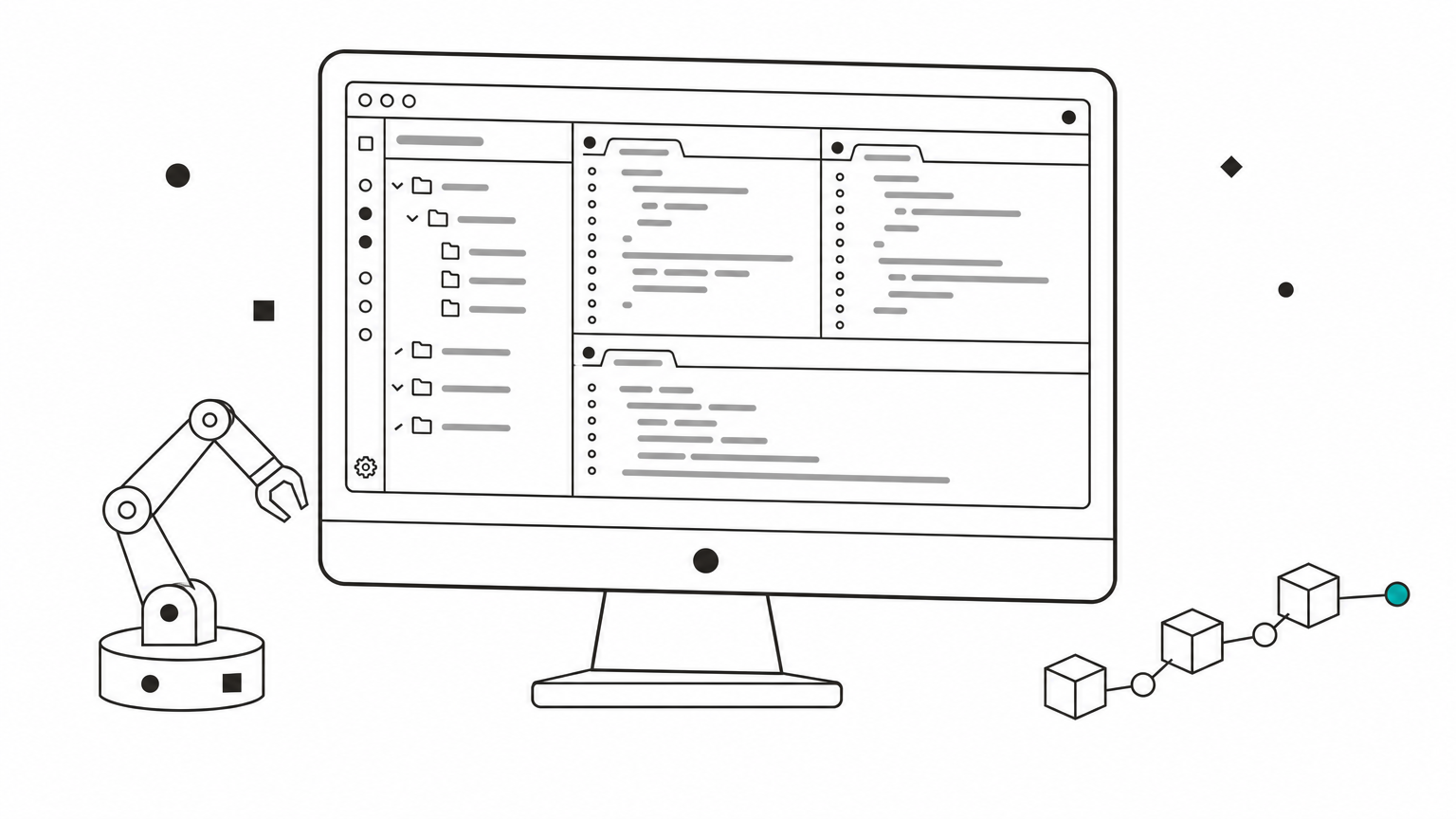
Repository-scale debugging and multi-file refactors are the other natural fit. The model takes text in and returns text out, so image or audio pipelines need a different model.
Full model versus Flash
GLM 5.3 and GLM 5.3 Flash are two separate endpoints. Flash is the cheaper tier, and Geodd lists it for coding agents, repository-scale debugging and tool-using workflows. On Geodd it has a 1.05M-token context window and up to 128K tokens of output.
Run your own prompts against both before you commit. A model that costs a twelfth as much often covers most of your traffic.
Evaluate GLM 5.3 and GLM 5.3 Flash as two models, because they have separate endpoints and separate prices.
How to get a GLM 5.3 API key and send a first request
You get a key by creating an account with a provider that hosts the model, generating a key in its dashboard, and pointing an OpenAI-style client at that provider's base URL.
Where the model is hosted
| Provider | What it offers |
|---|---|
| Z.ai API Platform | First-party GLM-5.3 access |
| Together AI | Serverless GLM-5.3 at $1.40 input / $4.40 output per million tokens |
| NVIDIA NIM | GLM-5.3 on build.nvidia.com, with account creation and key generation |
| DeepInfra | Hosted GLM 5.3 with a demo page |
| OpenRouter | A listing for the Flash variant |
| Geodd | GLM 5.3 Flash through an OpenAI-compatible API |
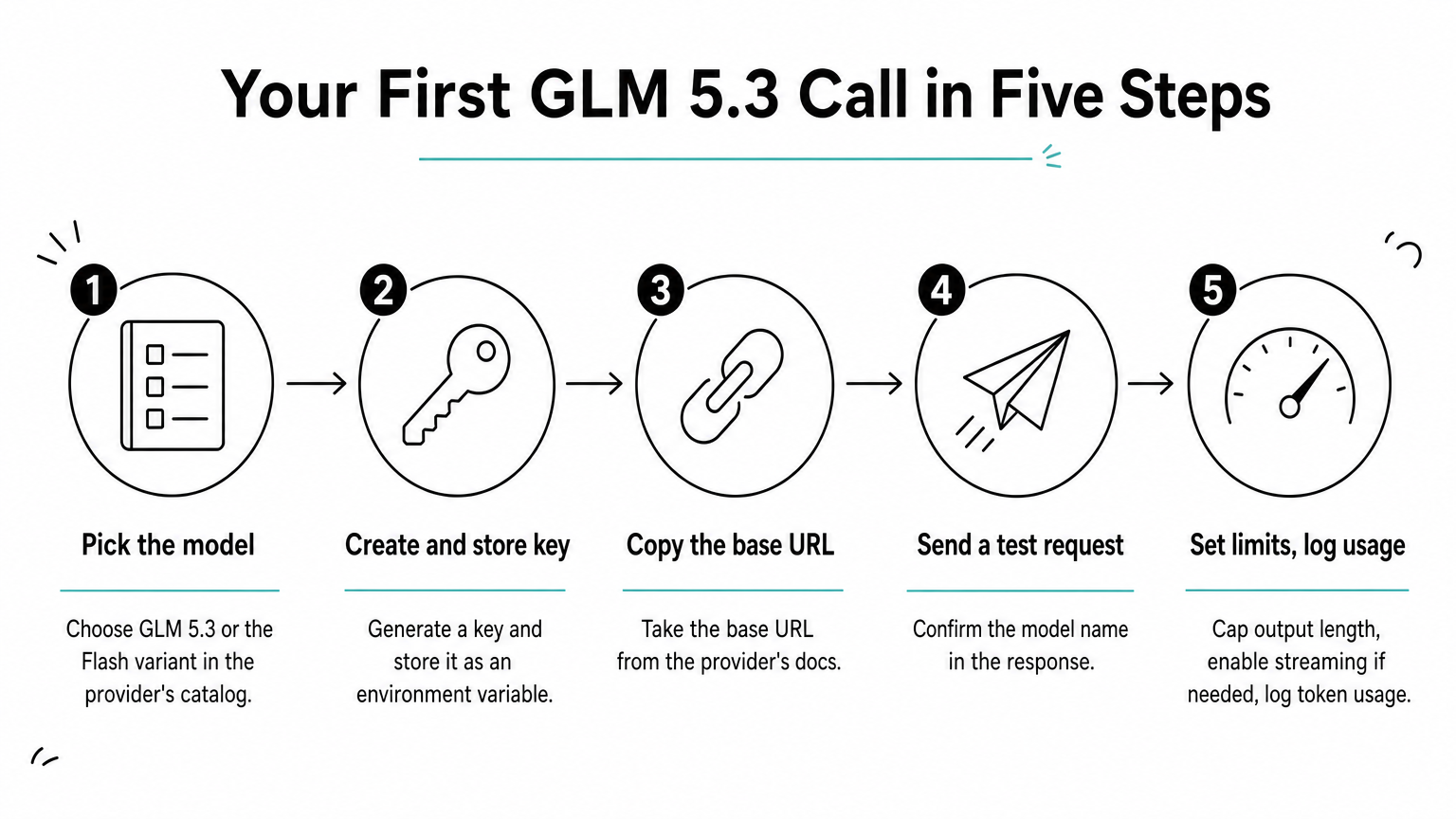
Your first call in five steps
- Pick the exact model in the provider's catalog: GLM 5.3 or the Flash variant.
- Create an account, generate a key, and store it as an environment variable. Never commit it to a repository.
- Copy the base URL from the provider's docs.
- Send a short test request and confirm the model name in the response.
- Set a maximum output length, turn on streaming if you need it, and log the token usage field.
import os
from openai import OpenAI

client = OpenAI(
    api_key=os.environ["PROVIDER_API_KEY"],
    base_url=os.environ["PROVIDER_BASE_URL"],  # copy from your provider's docs
)

response = client.chat.completions.create(
    model="zai-org/glm-5.3-flash",  # use your provider's exact model ID
    messages=[{"role": "user", "content": "Explain what this regex does: ^\\d{3}-\\d{4}quot;}],
    max_tokens=300,
)
print(response.choices[0].message.content)
print(response.usage)
Model IDs differ by provider. Geodd's ID for the Flash model is zai-org/glm-5.3-flash.
Free keys, downloads and Hugging Face
A GLM 5.3 API key is a credential, not a file, so there is no "API download". Z.ai publishes the model as open weights. That means you can self-host it, but a model this size needs serious multi-GPU hardware.
Be careful with free API key offers from videos and unknown routers. A middleman that proxies your requests can see your prompts. Use trial credits that a provider grants you directly, and keep sensitive code away from keys you cannot trace.
A key is a credential from a hosted provider, not a file you download.
GLM 5.3 API pricing: full model versus Flash
GLM-5.3 costs $1.40 per million input tokens and $4.40 per million output tokens on Z.ai's API. That is unchanged from GLM-5.2, and cached input is listed at $0.26. GLM 5.3 Flash on Geodd costs $0.110 input and $0.400 output.
List prices side by side
| Model | Provider | Input per 1M tokens | Output per 1M tokens |
|---|---|---|---|
| GLM-5.3 | Z.ai API | $1.40 | $4.40 |
| GLM-5.3 | Together AI | $1.40 | $4.40 |
| GLM 5.3 Flash | Geodd | $0.110 | $0.400 |
A worked monthly example
Take a coding assistant that uses 50M input tokens and 10M output tokens per month. On full GLM-5.3 at $1.40 and $4.40, that is $70 plus $44, or $114. On GLM 5.3 Flash at $0.110 and $0.400, it is $5.50 plus $4.00, or $9.50.
The full model costs about 12 times more for the same traffic. Whether the extra capability justifies that is a question for your own evaluation set.
What moves the bill
Output tokens cost about three to four times as much as input tokens on both models. Reasoning models usually bill their thinking tokens as output, so a verbose chain of thought raises the cost. Cap maximum output, and use prompt caching where your provider offers it, since the cached input rate is far below the standard one.
Output tokens cost roughly three to four times as much as input tokens, so cap output length first.
How to choose a GLM 5.3 API provider
Choose a provider by checking exact model version, price, data handling, region and SDK compatibility. Most teams only need to compare two or three candidates on those five points.
Five checks before you commit
- Exact version: confirm whether the endpoint is GLM-5.3, GLM 5.3 Flash or an older GLM release. Providers list several, and pages for one version often show another's numbers.
- Price: compare input, output and cached input rates, not one blended figure.
- Data handling: find out whether prompts and outputs are stored or used for training.
- Region: confirm where inference runs and whether that satisfies your requirements.
- Compatibility: an OpenAI-compatible API lets you switch providers by changing the base URL and key.
The last check is your exit plan. If your code only calls the standard chat completions interface, you can move between providers without a rewrite.
Data handling and region on Geodd
For GLM 5.3 Flash, Geodd lists US-EAST as the region and zero data retention by default. Geodd does not use API data for model training. It stores prompts, outputs or uploaded files only if you agree to that in writing.
Check the model page for current regions before you plan around a location. If you need a specific region, ask before you build.
Pick the provider whose version, region and data policy match your requirements, then let price break the tie.
Picking your GLM 5.3 starting point
The GLM 5.3 API gives you a capable coding and agent model at standard per-token prices, from several providers. Decide first whether you need the full model at $1.40 and $4.40 or the Flash tier at a fraction of that. Then run a real test with your own prompts, and compare providers on version, data handling and region.
If you want to test the Flash tier, you can use the GLM 5.3 Flash API on Geodd. It has token pricing, SDK examples and coding-agent integration guides in one place.