An AI agent versus agentic AI comparison comes down to a noun and an adjective. An AI agent is a piece of software that takes input, decides what to do, and acts toward a goal, usually by calling tools such as APIs, databases, or code runners. Agentic AI describes a behavior: AI that plans multi-step work, adapts when something fails, and acts with some autonomy. The two terms are related but not identical. An agent is a thing you deploy, and "agentic" is how much agency that thing has.
Writers use the terms loosely. Some treat agentic AI as the whole system and agents as the workers inside it. Others use the two as synonyms. This article takes the most practical reading. It explains why the difference matters, how to tell the two apart, what real examples look like, how both relate to generative AI and LLMs, and what to check before you build.
Geodd runs inference for the models that power agents, and we use AI agents of our own to tune how models run on GPUs. That gives us a view from both sides: what builders need from the model layer, and what an agentic loop does in production. The last section turns that into a checklist and a cost example you can reuse.
Why the difference between AI agents and agentic AI matters
The difference matters because it changes what you build, what you buy, and how much can go wrong. If you treat every agent as agentic, you will expect a ticket-routing bot to run a whole onboarding process. If you treat agentic AI as a product category, you will pay for orchestration you may not need. Getting the terms right is a scoping decision, not a vocabulary exercise.
Two ways the terms are used
Sources disagree on definitions, and you should know how before you compare articles. One camp, common among enterprise vendors, says agentic AI is the system that plans and coordinates many agents, while an AI agent is a single-task worker inside it. A second camp treats agents as one component of the broader idea of agentic AI. It says the number of agents is not the point. The point is whether the system can pursue goals with a suitable level of autonomy and oversight.
The adjective reading is the most useful one, because it holds up against real products. Take two agents. A rule-based bot checks a failed badge scan and opens a ticket. A coding agent reads a repository, plans changes, edits files, runs tests, and rewrites its own patch when the tests fail. Both are agents. Only the second is strongly agentic, so agentic is a dial, not a switch.
An AI agent is something you deploy. Agentic describes how much freedom it has to decide.
What goes wrong when you mix them up
Confusion shows up in four places, and each one costs money or trust.
- Scoping: you expect a single-purpose agent to run a cross-system workflow, and it stalls at the first exception.
- Buying: you purchase an agent tool when you need coordination across steps, or you pay for a planning layer when one fixed task would do.
- Risk: a narrow agent can make narrow mistakes. A highly agentic system can chain small errors into large ones, so it needs permissions, step limits, and human approval for irreversible actions.
- Cost: agentic loops call a model many times per task, so the bill scales with steps, not with requests.
How to tell an AI agent from agentic AI
You can tell them apart by asking who chooses the steps, how far the system acts, and what happens when a step fails. The more those answers point to the system itself instead of to a script you wrote, the more agentic it is. In the AI agents vs agentic AI debate, these questions settle most cases faster than any definition.
A side-by-side comparison
The table below puts the two terms next to each other. Read the AI agent column as the typical case, since agents range from reactive to quite capable.
| Question | AI agent | Agentic AI |
|---|---|---|
| What it is | A software component with a goal, tools, and a decision loop | An approach or property: planning, adapting, and acting across steps, often with several agents |
| Part of speech | Noun | Adjective |
| Who picks the steps | Often you, through rules or a fixed flow | The system, working from a goal you set |
| Scope | One task or one system | A whole workflow, often several systems |
| When a step fails | Stops, errors out, or hands off | Replans, retries, or asks for help |
| Main risk | Narrow, local mistakes | Compounding mistakes across steps and systems |
| Example | Ticket-routing agent | Coding agent that plans, edits, tests, and revises |
Four tests you can apply
Run any system through these four tests. They work for a vendor demo, an open-source framework, or your own prototype.
- The goal test: are you giving it a task ("classify this ticket") or an outcome ("resolve this ticket")?
- The plan test: does it choose its own sequence of steps, or follow one you wrote?
- The recovery test: when a tool call fails or returns something odd, does it adjust its plan?
- The reach test: how many systems and decisions can it touch before a human looks at the result?
Score one point for each answer that favors the system. With zero or one point, you have a plain agent. With three or four, you have something agentic. So are they the same thing? No. Every agentic system contains at least one agent, but many agents are barely agentic.
If you wrote the steps, it is an agent. If it wrote the steps, it is agentic.
Examples from simple agents to fully agentic systems
Examples fall on a ladder, and the right rung depends on how much of the plan the software owns. The table shows five common cases, from the least to the most agentic.
A ladder from reactive to agentic
| Rung | Example | What it does | How agentic |
|---|---|---|---|
| 1 | FAQ bot with fixed lookups | Matches a question to a stored answer | Very low, closer to an assistant |
| 2 | Ticket-triage agent | Classifies a ticket and routes it | Low: one step, one tool |
| 3 | Support agent with tools | Looks up an order, checks policy, issues a refund within a limit, drafts a reply | Medium: loops until resolved |
| 4 | Coding agent | Reads a repo, plans changes, edits files, runs tests, fixes failures | High: owns the plan and recovery |
| 5 | Multi-agent incident response | Detection, log-gathering, and containment agents run under a coordinator | Highest: an agentic system |
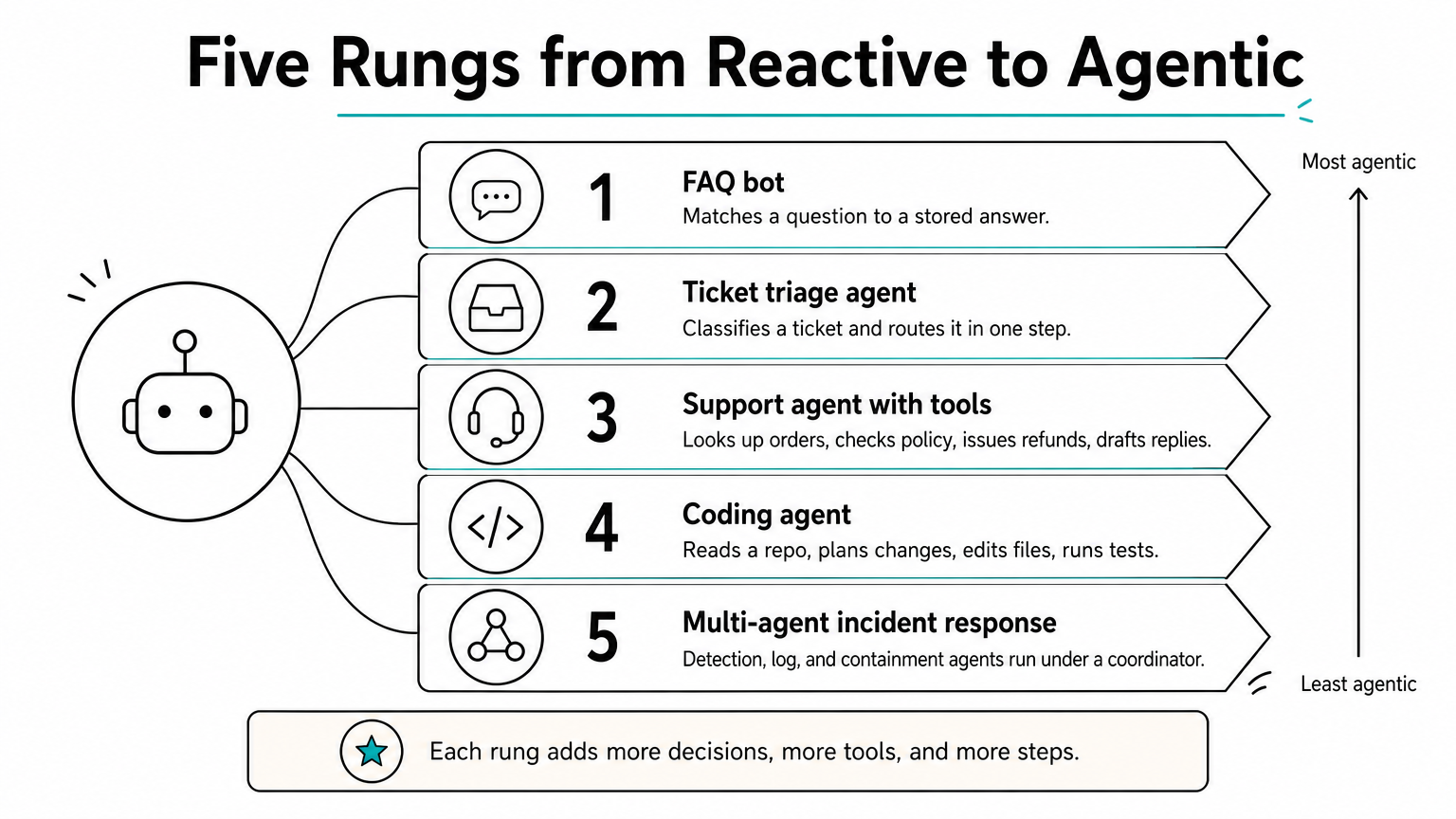
Moving up a rung adds three things: more decisions made by the software, more tools it can call, and more steps between a human and the outcome. Those same three things are why the cost and risk climb with each rung.
A real example: agents that tune inference kernels
Geodd's own engineering work is a good example of an agentic system. Our AI agents look for bottlenecks in how a model runs on a GPU, write hardware-specific kernel code, and test it for correctness and performance in staging. Verified improvements are deployed into serving, and the agents then watch how production performance changes. The loop has a goal, uses tools, tests its own work, and feeds results back into the next attempt.
One published result shows what the loop can deliver. Our optimisation agent raised Qwen2.5-7B generation from 128.57 to 195.16 tokens per second per request on a single NVIDIA H200, a 51.8% increase. The guardrail matters as much as the speedup, because nothing ships until it passes tests. That is what a well-run agentic system looks like: autonomy inside a verification step.
How AI agents and agentic AI relate to generative AI and LLMs
An LLM is a model, generative AI is the kind of output it produces, an AI agent wraps a model in a loop with tools and a goal, and agentic AI is the behavior that results. If you also search for how an AI agent differs from an AI model, this is the answer: a model returns output, while an agent decides what to do with it.
Models, assistants, and agents
Think in three layers. The model layer is the LLM, which takes text in and returns text out. The application layer is a product built on it, such as a chat assistant that answers when prompted and waits for the next prompt. The agent layer adds tools, memory, and a loop, so the system can act, check the result, and decide the next step.
That is why "Is ChatGPT an agent or an LLM?" has two honest answers. The model underneath is an LLM, and the chat product is mostly an assistant. When it is given tools and runs a multi-step task on its own, it behaves as an agent. The label depends on the mode you use, not on the brand.
Multi-agent systems and the classic agent types
A multi-agent system is several agents working on one problem, usually with a coordinator that assigns work and merges results. Having many agents does not make a system agentic. Ten agents that each run a fixed script are still ten scripts. The coordination has to plan and adapt.
Textbooks sort agents into five classic types, and some lists stretch the count to seven by adding hierarchical and multi-agent systems. The five core types are:
- Simple reflex: reacts to the current input with fixed rules.
- Model-based reflex: keeps an internal picture of the world.
- Goal-based: picks actions that move toward a target.
- Utility-based: weighs outcomes and picks the best trade-off.
- Learning: improves from feedback over time.
There is no standard "big four" list of agents. Lists with that title rank products, and the rankings change every few months.
How to build one and what the inference layer needs
Build the smallest agent that does one useful job, then raise its autonomy only as far as your evidence supports. Whatever you build, the model layer must support tool calling, structured outputs, and enough context for many sequential calls. The same checks apply when you compare agentic AI vs AI agents for a purchase.
A cautious path to your first agent
This path keeps the first version small enough to debug.
- Pick one narrow task and write down what "done" means in a way you can test.
- Give the agent two or three tools, not twenty.
- Cap the loop with a maximum step count and a token budget.
- Require human approval for anything irreversible, such as refunds, deletions, or deployments.
- Log every model call and tool call, so you can replay failures.
- Add autonomy only after the logs show the agent behaving reliably.
Raise autonomy only when your logs, not your hopes, say the agent has earned it.
Model features that matter for agents
Agent loops live or die on a few capabilities. This table uses the listings for three text models served on Geodd through an OpenAI-compatible API, all in US-EAST with zero data retention by default.

| Model | Input / output per 1M tokens | Context | Tool calling | Structured outputs | Reasoning |
|---|---|---|---|---|---|
| GPT-OSS-120B | $0.039 / $0.158 | 131.07K | Yes | Yes | Yes |
| GLM 5.3 Flash | $0.110 / $0.400 | 1.05M | No | Yes | Yes |
| DeepSeek V4.1 Flash | $0.300 / $1.100 | 1.05M | Yes | Yes | Yes |
Tool calling is the deciding feature for most agent loops. GLM 5.3 Flash is listed without it, so it fits reasoning and long-document steps better than a loop that must call functions. Two other points matter in production. Rate limits are shared across API keys for each model, so giving every agent its own key does not multiply capacity. And agents send tool outputs and documents through the model, so a no-retention default matters.
A worked cost example
Suppose one agent run makes 10 model calls, each with 8,000 input tokens and 500 output tokens. That is 80,000 input tokens and 5,000 output tokens per run.
| Model | Cost per run | Cost per 1,000 runs |
|---|---|---|
| GPT-OSS-120B | $0.00391 | $3.91 |
| GLM 5.3 Flash (no native tool calling) | $0.0108 | $10.80 |
| DeepSeek V4.1 Flash | $0.0295 | $29.50 |
Real loops often resend a growing history, so input tokens rise with every step. Measure a real trace before you commit, and price per task, not per request. Because the API is OpenAI-compatible, you can test each model by changing the model ID and key in your existing OpenAI SDK code.
The short answer
AI agents are the parts, and agentic AI is the goal-driven behavior that emerges when those parts plan, act, recover, and coordinate. An agent can be simple and scripted, or strongly agentic. Use the four tests (goal, plan, recovery, reach) to see where a system sits, and match its autonomy to the risk of the task.
For your first build, keep the scope narrow, cap the loop, and watch the logs. Then pick a model that supports tool calling and fits your token budget. If you want to test an agent loop against a priced, OpenAI-compatible endpoint, you can try GPT-OSS-120B through Geodd's API and compare it with your current provider on your own traces.