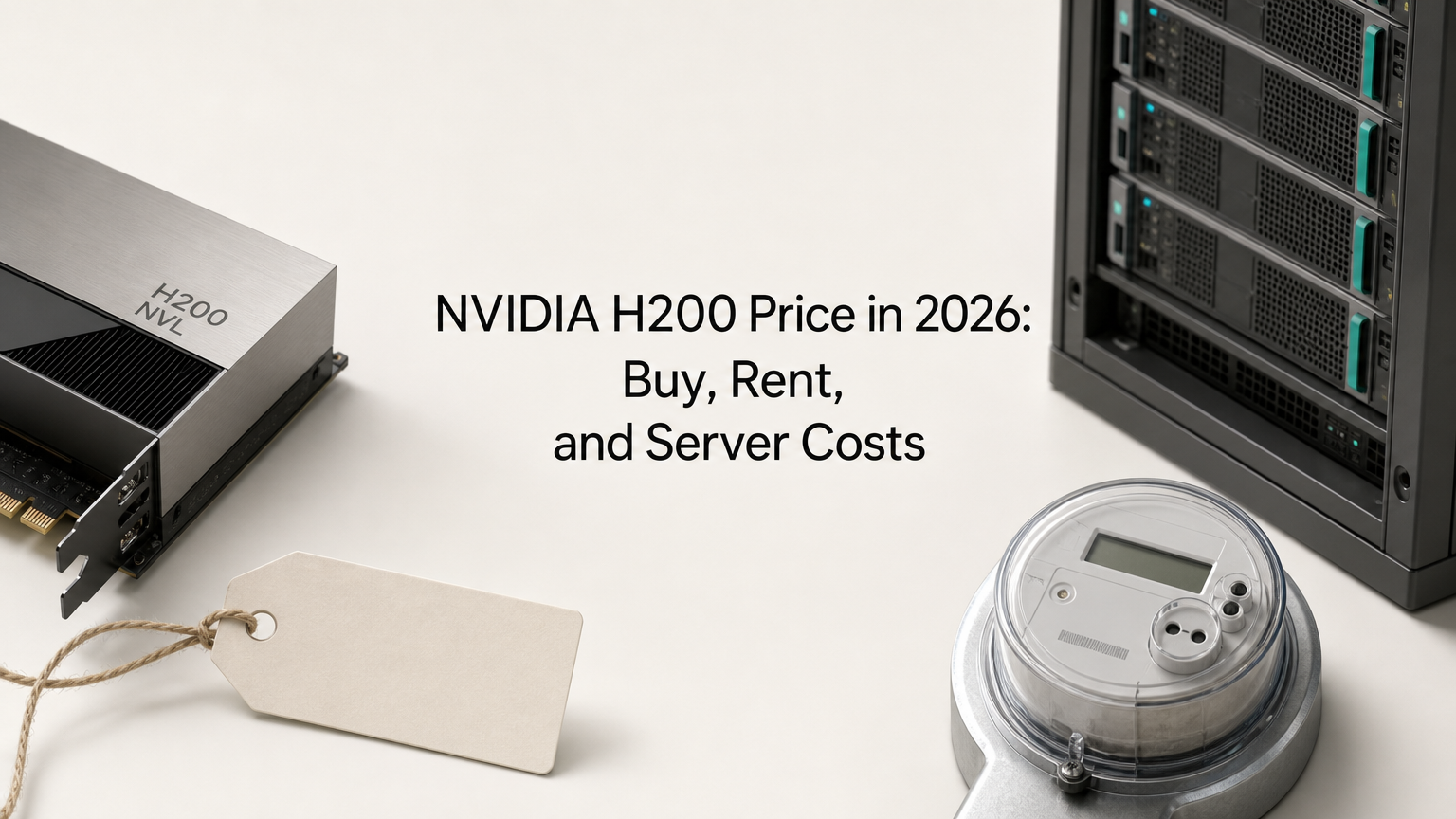
The NVIDIA H200 price depends on how you buy it. A single H200 NVL card costs about $31,000 to $32,500 from a reseller. An 8-GPU HGX server runs roughly $293,000 to $315,000. Renting one GPU in the cloud costs about $3.50 to $10.85 per GPU-hour. The H200 is NVIDIA's Hopper-generation data center GPU, with 141GB of HBM3e memory and 4.8 TB/s of memory bandwidth, built for large-model inference and memory-bound training.
That spread confuses many first-time buyers. The label "H200" covers two form factors, several system sizes, and very different sales channels. This article explains why the numbers differ, what each purchase and rental option costs, and how to turn a workload into a budget you can defend to finance.
Geodd rents dedicated H200 GPUs by the hour and reserves larger clusters for funded projects, so the rental section sets our published rates next to the market range. Purchase prices come from reseller and integrator quotes seen in late 2026. They move, so treat each figure as a planning range and confirm it before you commit.
Why the H200 price is not one number
The H200 price varies because you can buy it as a card, a board, a full server, or by the hour, and each path has a different cost basis. Three factors explain most of the spread: the memory upgrade, the form factor, and the lack of a published list price.
What the extra money buys
The H200 reuses the Hopper GH100 die from the H100. The change is memory. It carries 141GB of HBM3e instead of 80GB of HBM3, which is 76% more capacity. Its 4.8 TB/s of bandwidth compares with 3.35 TB/s on the H100 SXM, which is 43% more. Peak compute is unchanged, so the H200 pays back only when memory limits your workload. NVIDIA lists the full specifications on its H200 product page.
Model size makes this concrete. A 70B-parameter model in FP8 needs about 70GB for weights, so it fits on one H200 with room for the KV cache. In FP16 the same model needs about 140GB for weights alone, so you need two cards. Budget 10% to 30% above the weights for the KV cache, activations, and framework buffers.
You pay for memory, not compute: the H200 is an H100 die with 76% more capacity and 43% more bandwidth.
How SXM and NVL change the price
The H200 ships in two forms. H200 SXM runs at up to 700W and comes on 4- or 8-GPU baseboards, where NVSwitch links every GPU at 900 GB/s. H200 NVL is a PCIe card capped at 600W that fits ordinary air-cooled servers. NVLink bridges connect two or four cards. That power cap costs the NVL about 16% of the SXM's peak FP8 throughput.
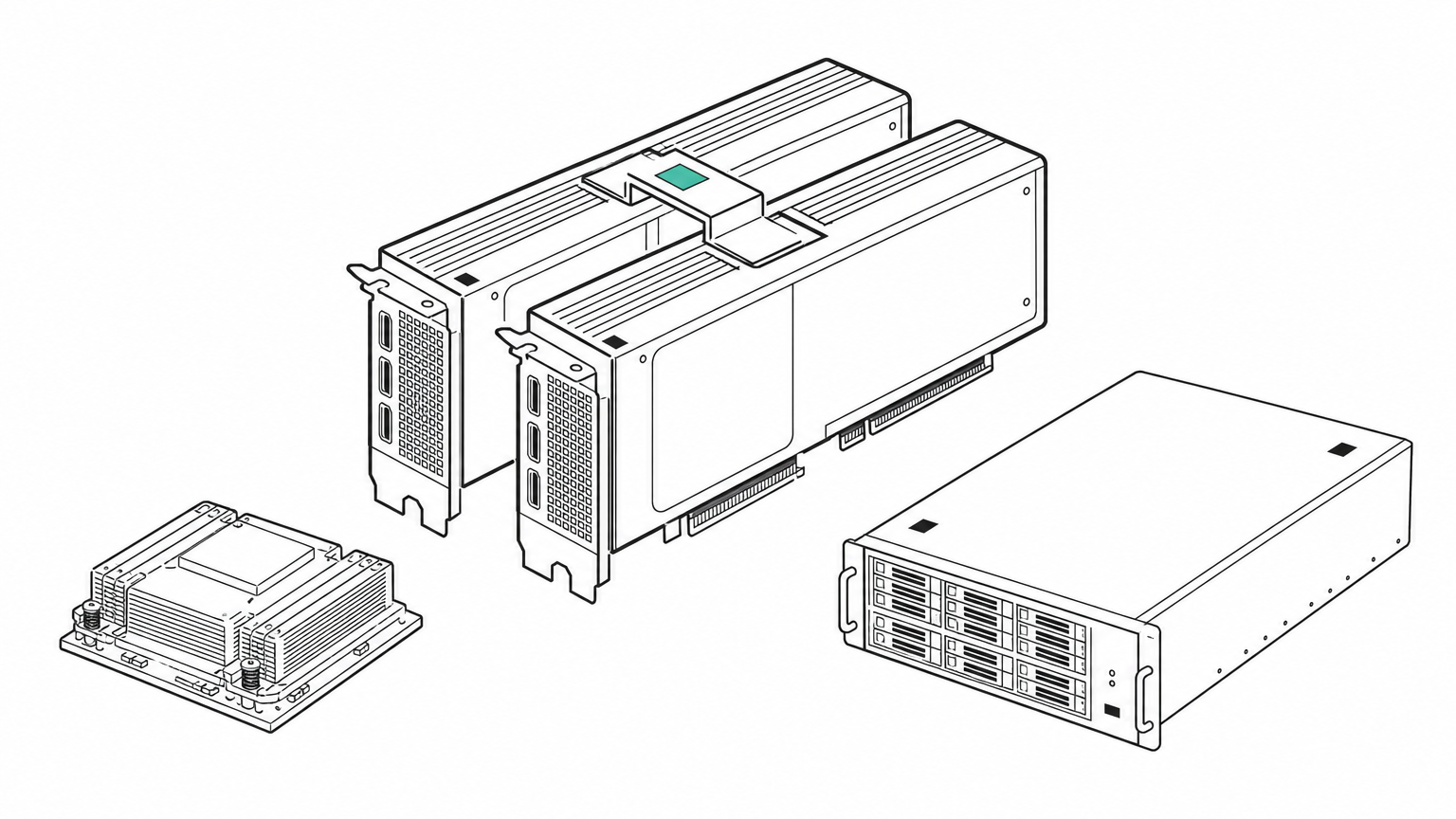
The form factor decides what you can actually order. You can buy a single NVL card. SXM GPUs generally come only on boards, so a "single SXM" price you see online is usually an estimate, not something you can order. If you rent, the rate often follows the same split.
Why quotes disagree
NVIDIA does not publish list prices for data center GPUs. Buyers rely on OEM and reseller quotes and on secondary-market listings, so two quotes in the same week can differ by thousands of dollars. Supply swings add to it. Across providers that rent both cards, the H200 averages about 12% more per GPU-hour than the H100. On Geodd, a single H200 NVL at $3.50 per hour sits about 17% above a single H100 SXM5 at $3.00.
Search results also surface an "H300." NVIDIA's data center lineup has no such product. The H200's successors are Blackwell parts, the B200 and B300, which are reserve-only on Geodd with pricing on request. For most funded teams today, the H200 remains the practical Hopper choice when 141GB is enough.
What it costs to buy an H200 outright
Buying an H200 costs about $31,000 to $32,500 for one NVL card and roughly $293,000 to $315,000 for an 8-GPU HGX server. A DGX H200 has no published price and is quoted through NVIDIA partners.
Purchase prices by configuration
The table sets late-2026 quotes side by side. Figures are planning ranges, not offers.
| Configuration | Typical price | What you get |
|---|---|---|
| Single H200 NVL card | $31,000 to $32,500 from resellers | One 141GB PCIe card. You still need a compatible server. |
| Custom NVL server | $100,000 to $350,000 | Partner-built, price depends on GPU count and NVLink bridges. |
| 4-GPU SXM board | $160,000 to $220,000 | Four SXM GPUs linked by NVLink. |
| 8-GPU HGX H200 server | $293,000 to $315,000 | Eight SXM GPUs, NVSwitch, CPUs, chassis, networking. |
| DGX H200 | Quote only | Eight H200 SXM GPUs, 1,128GB total GPU memory. |
Some listings for 8-GPU servers go as high as $350,000 to $500,000, usually from resale channels or with extra configuration. An 8-GPU server also costs more than eight cards. Eight NVL cards at about $32,400 is roughly $259,000, and the server adds CPUs, NVSwitch fabric, chassis, and networking.
Plan on about $300,000 for an 8-GPU H200 server, not eight times the card price.
DGX H200 versus HGX
HGX is the baseboard that OEMs build into their own servers. DGX is NVIDIA's own 8-GPU system, with the same eight H200 SXM GPUs and 1,128GB of total GPU memory. NVIDIA does not post a DGX price, so request quotes through a partner.
Compare DGX and HGX quotes line by line. Both use eight SXM GPUs. They differ in CPUs, system memory, storage, networking, and support terms.
Where to buy and what to watch
Buy through resellers and system integrators that provide a warranty and a delivery date. Lead times of several weeks are common for cards, and servers can take longer. On open marketplaces, a "new" H200 listed for around $1,440 is an accessory, a deposit, or a scam. Pre-owned auctions near $21,500 exist, but you inherit unknown usage history and often no warranty.
The sticker price is only part of the cost of ownership. An 8-GPU system draws about 10.2 kW. At $0.13 per kWh, that is roughly $1.33 per hour, or about $11,600 per year in electricity alone. Add cooling, rack space, networking, and staff time, and ownership only makes sense when you can keep the hardware busy.
What it costs to rent an H200 per hour
Renting an H200 costs about $3.50 to $10.85 per GPU-hour, and the type of provider explains most of the gap. Specialist clouds sit at the low end and hyperscalers at the high end.
Market rates by provider type
On-demand rates in late 2026 fall into three bands.
| Provider type | On-demand $/GPU-hour | Notes |
|---|---|---|
| Specialist GPU clouds | About $3.99 to $5.40 | Single-GPU rental is common. |
| Marketplaces | Median about $4.61, hosts $3.54 to $5.84 | Hardware and uptime vary by host. |
| Hyperscalers | About $7.91 to $10.85 | Priced per 8-GPU node, divided by eight. Some are reservation only. |
A 10-hour test run costs $39.90 at $3.99 per GPU-hour and $108.45 at $10.85. Rates have also been rising. Two providers raised on-demand H200 prices by 15% and 20% in September and October 2026. The mean across eleven providers rose about 2% between August and November. If your project has a deadline, reserve capacity instead of betting on a lower rate later.
Provider type, not the GPU, sets most of the rental price gap: $3.99 versus $10.85 for the same H200.
Geodd H200 rates
Geodd publishes dedicated H200 configurations from one to eight GPUs. Rates are "from" prices.
| Configuration | Rate per hour | Total GPU memory |
|---|---|---|
| 1x H200 NVL | $3.50 | 141GB HBM3e |
| 2x H200 NVL | $7.00 | 282GB HBM3e |
| 4x H200 NVL | $14.00 | 564GB HBM3e |
| 8x H200 NVL | $28.00 | 1,128GB HBM3e |
| 8x H200 SXM | $29.00 | 1,128GB HBM3e |
The NVL rate scales linearly at $3.50 per GPU. The 8-GPU SXM node costs $1 per hour more than the 8-GPU NVL node. Published pricing does not guarantee immediate capacity in every configuration, so confirm availability for your size and start date. For clusters of 128 to 500 GPUs, enterprise customers can reserve dedicated nodes with deployment within 7 weeks, and the dedicated GPU deployment page covers single-tenant servers and direct access.
How to budget an H200 rental or purchase
Budget an H200 project by converting your workload into GPU-hours, then comparing that total with the purchase price plus running costs. Do this before you ask anyone for a quote.
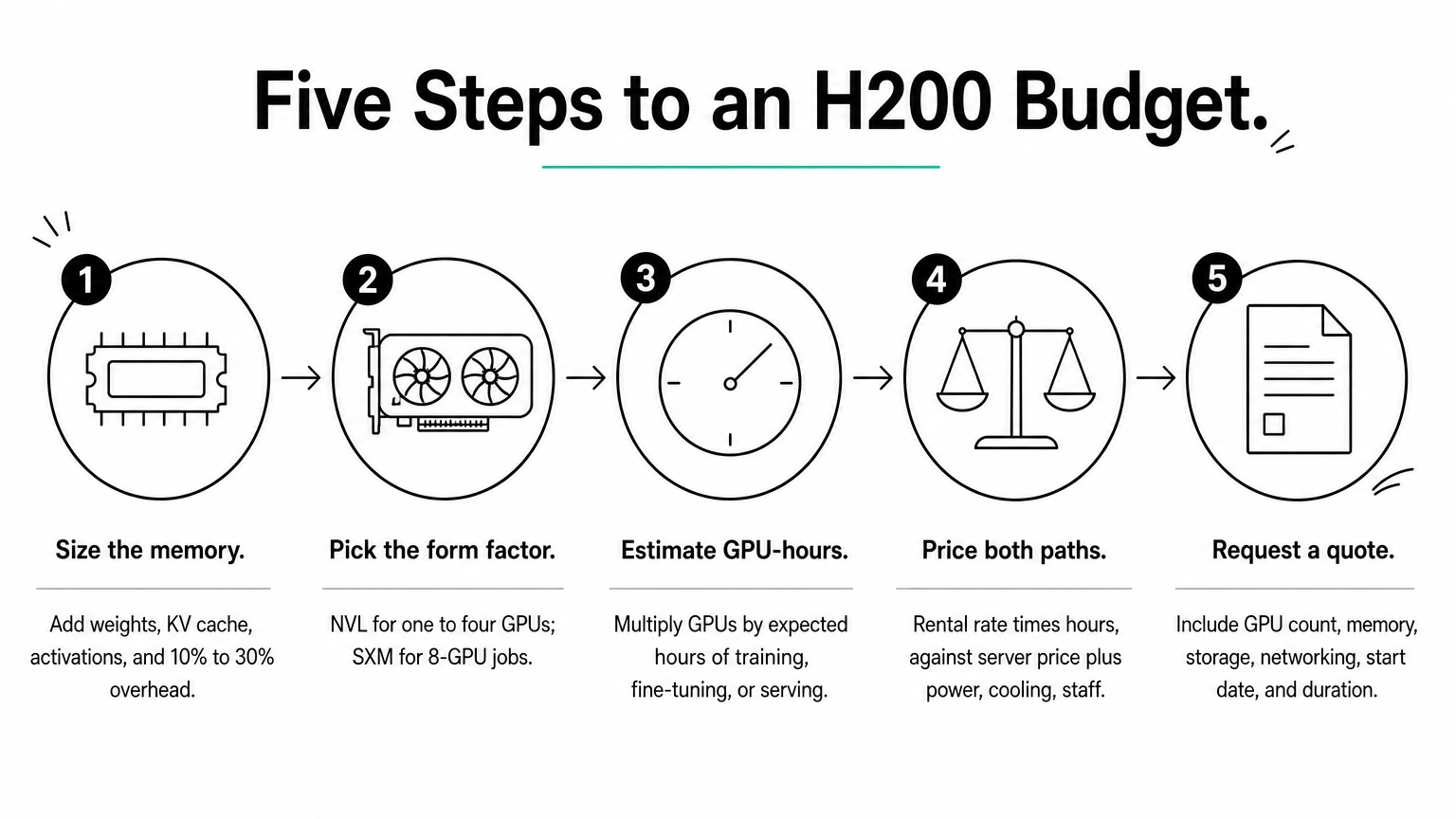
A five-step budgeting process
- Size the memory. Add weights, KV cache, activations, and 10% to 30% overhead. This tells you the GPU count.
- Pick the form factor. Choose NVL for one to four GPUs in standard servers. Choose SXM for 8-GPU jobs that move a lot of data between GPUs.
- Estimate GPU-hours. Multiply GPUs by the hours of training, fine-tuning, or serving you expect.
- Price both paths. Use the rental rate for the hours you need. For ownership, use the server price plus power, cooling, and staff.
- Request a quote with a specification. Include GPU count, memory, storage, networking, start date, and duration.
A worked example: one 8-GPU SXM node
Take an 8x H200 SXM node at $29 per hour, against a $293,000 HGX server. The table shows what rental costs at three usage levels.
| Usage pattern | Node-hours per year | Rental cost at $29/hour | Share of $293,000 |
|---|---|---|---|
| Six-week project | 1,008 | $29,232 | 10% |
| 8 hours per day | 2,920 | $84,680 | 29% |
| 24/7 | 8,760 | $254,040 | 87% |
At nonstop use, the server's price is matched after about 10,100 hours, or 1.15 years. At 8 hours a day, it takes about 3.5 years. That comparison ignores power, cooling, staff, and resale value, and every one of those favors renting at lower utilization.
Rent for projects and bursts. Consider buying only when you can keep the hardware busy around the clock for more than a year.
Choosing between buying and renting H200s
The NVIDIA H200 price comes down to three numbers. Expect about $32,000 for an NVL card, about $300,000 for an 8-GPU server, and $3.50 to $10.85 per GPU-hour to rent. Memory drives the premium over the H100, the form factor decides what you can order, and utilization decides whether buying ever beats renting.
For most funded projects with a deadline, renting wins. Define your GPU count, memory needs, and dates, then compare quotes on the same specification. When you are ready, request H200 capacity from Geodd for on-demand rental or a reserved cluster.